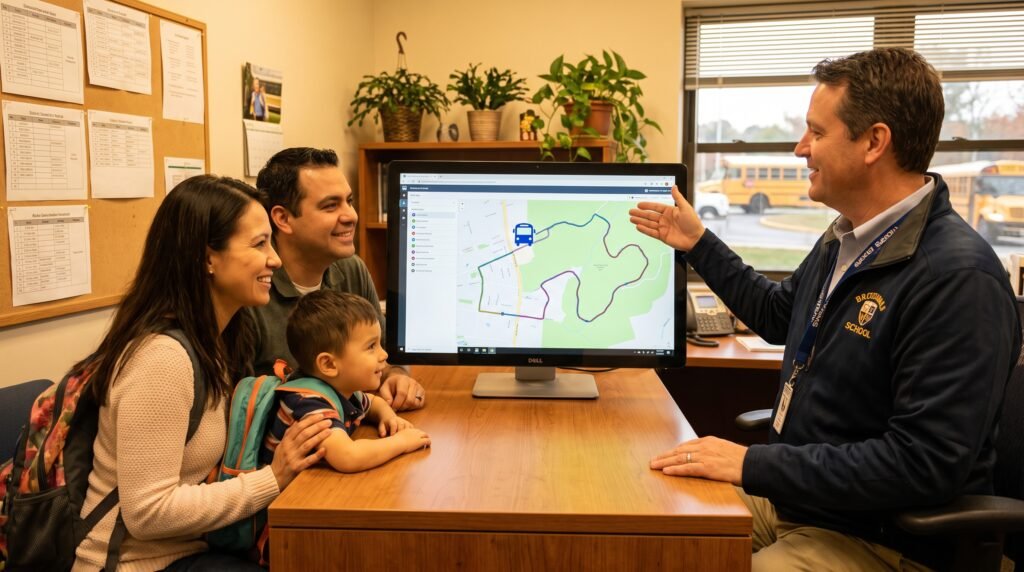
For newcomer families, registering a child at school is only part of preparing for the first day. The journey there can raise a separate set of questions: Is a school bus available? Does the home address qualify? Will an older child receive transit assistance instead?
Toronto school transportation depends on the school board, grade, designated school and individual circumstances. Living far from a school does not automatically mean a yellow bus will arrive outside your building.
Before arranging work hours or choosing an apartment around an expected pickup, confirm which transportation rules apply to your child. These checks can help families build a realistic school-day routine.
Start With the School Board and Assigned School
Identify the board operating your child’s school. The Toronto District School Board, known as TDSB, and the Toronto Catholic District School Board, known as TCDSB, publish different transportation criteria. Families attending a French-language board should consult that board’s guidance separately.
Next, ask whether the school is your child’s designated school for the home address and program. A school that accepts a child through an out-of-area application may have different transportation implications from one assigned by the board.
TDSB’s transportation FAQ distinguishes attendance at a designated school from attendance outside the school’s area, with exceptions identified for certain board placements and designated French immersion schools. Confirm the specific arrangement with the principal before assuming transportation accompanies admission.
A useful question is: “For this address, grade and program, is this the school used to assess transportation eligibility?”
Check What Support Your Child’s Grade May Qualify For
Transportation assistance can take different forms. A younger child might qualify for a school bus, while an older student may qualify for public transit fare support.
TDSB’s published elementary guidance says children in Junior Kindergarten through Grade 5 may be eligible for school bus transportation when they live at least 1.6 kilometres from their home school. For Grades 6 through 8, the published distance threshold for possible TTC ticket assistance is 3.2 kilometres. Applications are assessed individually.
For TDSB high school students, the published distance threshold for potential TTC assistance is 4.8 kilometres. Program restrictions and circumstances such as financial need can affect support, so families should discuss eligibility with the school.
TCDSB publishes a different elementary rule: Kindergarten through Grade 8 students must meet its 1.5-kilometre distance criterion and live within an approved transportation area. Its secondary TTC fare support is allocated according to financial need.
These differences matter when comparing advice from neighbours. Their child’s arrangement may belong to another board or grade group.
Make Sure the Address on File Is Accurate
Newcomers sometimes register while staying with relatives, in temporary accommodation or at an address they expect to leave shortly. Tell the school where the child currently lives and explain any planned move.
Check the street number, unit number, postal code and spelling against the registration record. If you are close to an eligibility threshold, ask how the board measured the distance. A driving route shown on a phone may not match the method used for a transportation decision.
If your housing documents are still being arranged, ask the school which residency evidence it accepts. Toronto Blog’s guide to Toronto proof of address explains why address evidence and identity documents serve different purposes.
Avoid using a future address to plan an immediate pickup. Confirm when the school can assess the new location and whether a separate application will be necessary.
Submit the Application Through the Correct Process
School registration and transportation approval are separate tasks. Ask the office whether a transportation application has actually been submitted, rather than assuming it was included in enrolment.
TDSB’s published process directs families to complete its Student Transportation Application Form and deliver a hard copy to the principal. The principal forwards it for eligibility review. Applications can be submitted throughout the year.
Before handing in paperwork, check:
- The child’s name matches the school record.
- The grade, school and program are correct.
- The residential address is complete.
- Parent or caregiver telephone numbers are current.
- Any requested supporting information is included.
Keep a copy and record the submission date. Ask who will communicate the decision and how you will receive route information if approved.
Arrange an interim journey while waiting. An application receipt does not establish a pickup date.
Raise Accessibility Needs Early
A standard distance check may not answer every child’s transportation needs. If a disability or medical condition affects travel, speak with the principal before the first school day.
TDSB states that students who use wheelchairs are eligible for transportation and that transportation may also be available where a medical condition or disability severely limits walking. Its guidance also provides for individual consideration of special education circumstances.
Explain the practical difficulty clearly. For example, describe whether the child needs help boarding, cannot safely manage a particular journey or requires equipment during travel.
Ask what documentation is required and which staff member coordinates the request. Do not assume an overseas diagnosis must be replaced before you can start the conversation; let the school explain its documentation requirements.
Confirm the Journey After Approval
Once transportation is approved, turn the decision into a workable daily plan.
For a school bus, request the route number, exact stop, morning pickup time, afternoon return arrangements and confirmed service start date. Ask whether an adult must meet the child and how to authorize another caregiver.
Visit the stop together beforehand. Check the walking route from your building, especially where there are busy crossings, construction or several similar entrances. The apartment’s front door may not be the assigned meeting point.
For a student receiving TTC support, ask how the school distributes fares. Practise the journey together, including transfers, the correct direction of travel and what to do after missing a stop.
Write down the school office number and a caregiver’s contact details. A child should have a way to ask for help even if a phone battery runs out.
Plan Separately for Child Care and Schedule Changes
Before-school care, after-school care and extracurricular activities can change the journey your family needs. Ask whether the approved transportation arrangement serves the location and times you require.
For example, a bus returning a child after regular dismissal may not solve pickup after an evening club. A parent starting work before the morning bus arrives may still need supervision arrangements.
Build a backup plan for delays or cancellations. Identify who can accompany the child, who can leave work if needed and how the school should be contacted about an absence.
Keep those instructions simple enough that another caregiver can follow them without reconstructing the arrangement.
Review Moves, Grade Changes and Refusals
A change of address can affect both the assigned school and transportation eligibility. TDSB states that families already receiving transportation must submit a new application when they move homes or change schools.
Before a new school year, also check whether moving into another grade changes the type of support available. A school bus arrangement in Grade 5 should not be treated as confirmation of the same arrangement in Grade 6.
If an application is refused, ask for the reason before preparing an appeal. Check whether the issue concerns distance, the address, school designation or missing information. TDSB provides an appeal process for transportation decisions.
An appeal is easier to assess when it identifies the disputed detail and includes relevant evidence.
Official Resources for Families
Use the public education resources below to check the rules applying to your child:
- TDSB elementary transportation eligibility
- TDSB transportation applications and appeals
- TDSB high school transportation guidance
- TCDSB student transportation guidance
Note: This article provides general information for newcomer families. Transportation policies, routes and application procedures can change. Confirm your child’s eligibility, approved travel arrangements and start date with the school before relying on transportation.