
Finishing a jigsaw puzzle can leave you with a familiar problem: you enjoyed assembling it, but you are unlikely to repeat it soon. Meanwhile, the boxes keep taking up cupboard space.
Toronto puzzle swaps offer a way to pass those puzzles along, discover different images and meet people who enjoy the same hobby. Toronto Public Library has listed puzzle social-and-swap events, providing a local setting for communal puzzling and exchanging puzzles to take home.
Before bringing a stack of boxes, check what the organizer accepts and prepare each puzzle honestly. A successful exchange depends on clear information about what the next person will receive.
Confirm Whether the Event Includes Trading
Read the full event description rather than relying on its title.
A communal puzzling session may involve working on shared puzzles without exchanging personal copies. A swap may use direct trades, a shared selection table or another arrangement.
Ask whether you must bring a puzzle to take one home, whether there is a limit and whether registration is required. Confirm any age restrictions or rules about children attending with an adult.
Check the current date, branch and meeting room before travelling. An older event listing can show that an activity has happened without establishing that it remains on the schedule.
Establish What “Complete” Means for Your Puzzle
The strongest basis for describing a puzzle as complete is having assembled it and checked the finished image.
If you completed it recently, make a note before taking it apart. A photograph of the finished puzzle can provide useful context, although it does not guarantee that every piece remained in the box afterward.
If you have never assembled it, say that completeness is unverified. Counting pieces can be a useful check, but it may not establish that there are no duplicates or pieces from another puzzle.
Avoid upgrading “the previous owner said it was complete” into your own guarantee. Pass along what you know and identify what remains uncertain.
Disclose Missing Pieces Before the Exchange
Check the organizer’s policy before bringing an incomplete puzzle. Some events may accept only complete copies; others may have different arrangements.
If an incomplete puzzle is accepted, label it prominently. Include the number of missing pieces if known and describe their approximate position.
A note such as “one piece missing near the upper-left corner” gives the next person something specific to consider. “Mostly complete” is less helpful when you know more.
Keep uncertainty visible too. If you suspect a piece is missing but cannot confirm it, explain that.
The label should be readable while someone is choosing a puzzle, rather than hidden beneath the pieces.
Inspect More Than the Piece Count
Completeness is only one part of condition.
Look for bent pieces, peeling surfaces, damaged tabs and pieces that have been joined with glue or tape. Check whether the image remains clear enough to assemble.
Inspect the box for moisture damage, strong odours or loose sections. If it contains dust, crumbs or unrelated objects, remove them carefully without damaging the puzzle.
Do not bring a damp puzzle or one showing signs of mould or pest contamination. A shared event is not an appropriate place to pass an unresolved condition problem to someone else.
Describe significant wear plainly. A battered box may still hold an enjoyable puzzle, provided the next person knows its condition.
Keep Every Puzzle’s Pieces Together
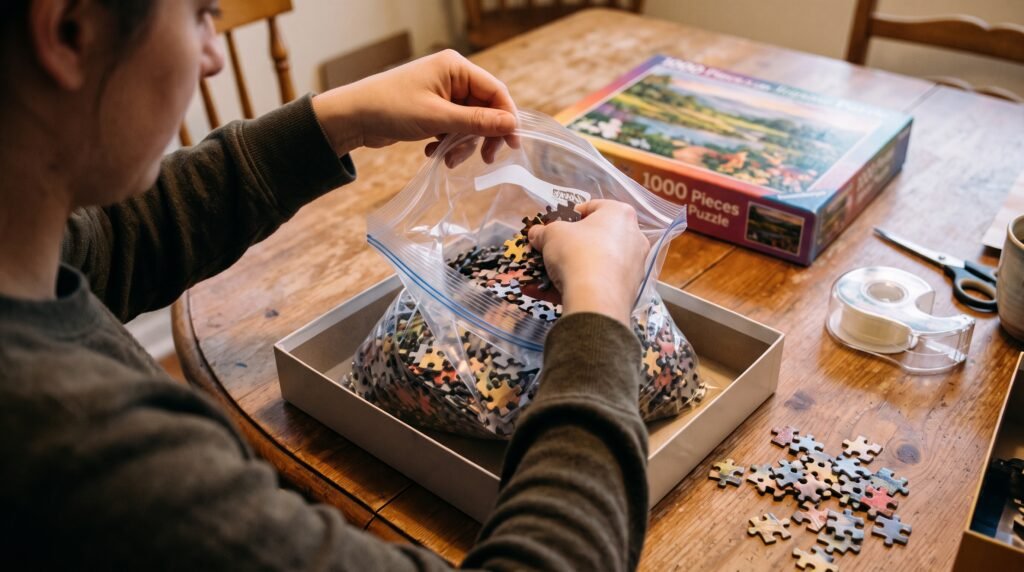
Bag the pieces inside the box before transporting it. Use a securely closed bag that fits without forcing the lid upward.
Check the table, floor and packaging after transferring pieces. A single overlooked piece can change an otherwise complete puzzle.
For a box containing several separate puzzles, keep each set in its own labelled bag. Make clear whether the exchange includes the entire collection or only one puzzle.
If you separate edge pieces for convenience, label that bag too. Make sure the recipient understands that it is part of the same puzzle.
Avoid combining loose pieces from several boxes in one carrier, even for a short journey.
Preserve the Image and Identifying Details
The box image helps someone decide whether the puzzle interests them and gives them a reference while assembling it.
Keep any included poster or reference sheet with the correct puzzle. If it is missing, disclose that before the exchange.
Make the title, stated piece count and finished dimensions visible where available. These details help someone assess the space and time involved.
If you are offering a puzzle without its original box, ask whether the organizer accepts it. Provide an accurate image and identifying information where you are entitled to reproduce them.
Do not use a photograph of a similar puzzle that could misrepresent what is inside.
Understand How the Exchange Handles Differences
Puzzles vary in size, condition and complexity. Check whether the event treats every accepted puzzle equally or separates them into categories.
Do not assume that a larger piece count entitles you to take several smaller puzzles. Follow the organizer’s system.
For direct exchanges, agree on what each person is receiving before handing over boxes. Either participant should be able to decline politely if the match does not suit them.
Choose for enjoyment rather than trying to calculate a perfect resale value. Someone may prefer a modest landscape puzzle over a larger design they would never assemble.
Clear expectations prevent an informal community activity from becoming an uncomfortable negotiation.
Choose Your Next Puzzle for Your Actual Setup
Look beyond an attractive lid image.
Check the finished dimensions against the surface you use at home. Consider whether you can leave the puzzle undisturbed or need to pack it away between sessions.
Think about the experience you want. Repeated patterns, large areas of similar colour and unusual piece shapes can produce a different challenge from a detailed illustration with many distinct sections.
Inspect the condition label and ask questions before choosing. If you are returning to the hobby after a break, a manageable puzzle may be more satisfying than the most demanding option available.
There is no requirement to trade up in size each time.
Keep the Social Part Comfortable
A puzzle gives you an easy conversation starter: ask what the other person enjoyed about assembling it or which section was most challenging.
You do not need to explain your entire puzzle history or stay for the full session unless the event requires it. Introduce yourself to the organizer if you arrive alone and are unsure how to participate.
Ask before opening someone else’s box or handling a puzzle they have not yet offered for exchange.
For broader ideas about building a regular activity around your time and budget, our guide to finding an affordable weekly hobby in Toronto provides useful planning questions.
Plan What Happens to Unswapped Boxes
Confirm whether you must take home anything that remains. Do not assume the host accepts donations simply because it is organizing a swap.
Bring a manageable number of puzzles and a bag that can carry both your original boxes and any replacements.
Before leaving, check that each selected box contains the expected bagged pieces and any promised reference sheet. Keep labels attached so the condition information travels with the puzzle.
At home, record what you received and any condition notes. When you eventually pass it along, update that information based on your own experience.
That simple habit helps useful details survive as puzzles move between households.
Helpful Public Resource
Visit Toronto Public Library’s event listings and search for “puzzle” to check current activities, locations and participation instructions. A puzzling event may have a different format from a swap, so read the individual listing carefully.
Note: Exchange rules, accepted conditions and donation arrangements vary by organizer. Confirm current instructions before travelling, label missing pieces honestly and take home unswapped puzzles unless the host expressly agrees to keep them.