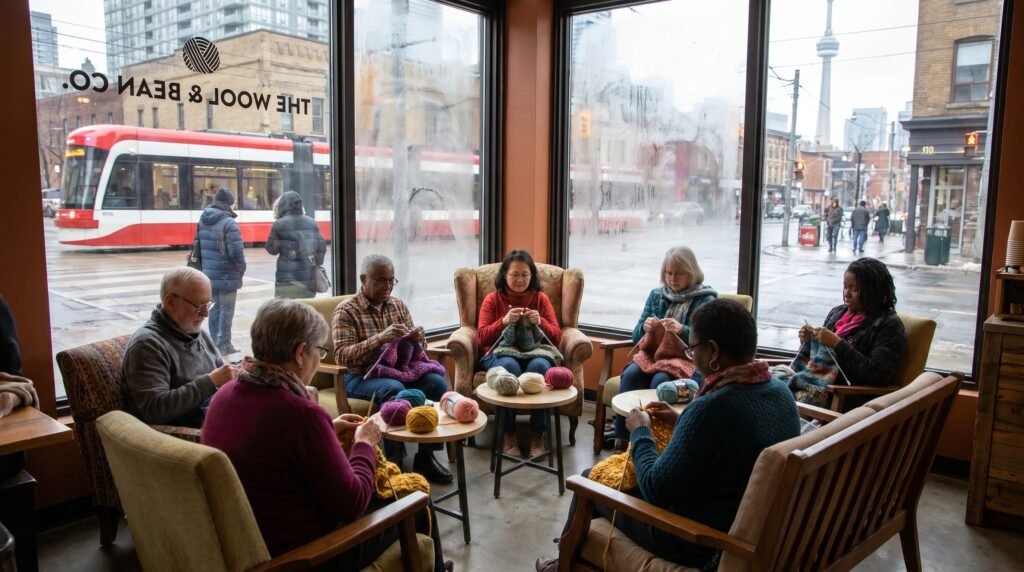
A knitting circle offers a simple way to spend time with people while working on something with your hands. You can bring a project, exchange ideas and gradually get to know other participants without having to keep a conversation going for an entire evening.
Your first visit is easier when you understand how the group operates. Some gatherings focus on social knitting, while others include instruction or a shared project. A welcoming description does not necessarily mean that needles, yarn and individual teaching are provided.
Before joining a Toronto knitting circles, check the format, choose manageable supplies and find out what support is available at your experience level.
Find a Group That Matches Your Starting Point
Begin with current library programmes, community noticeboards and neighbourhood event listings. Search for terms such as “knitting circle,” “knit and crochet group” and “social stitching,” alongside the area you can reach regularly.
Toronto Public Library describes knitting and crochet circles across the city as welcoming a range of participants, from beginners to experienced crafters. Individual programme details still matter when choosing a session.
Look for a description that explains what happens during the meeting. Does everyone bring an existing project? Is there a planned demonstration? Are crochet and other fibre crafts welcome?
Choose based on the activity you want rather than the group’s name alone. Someone learning to cast on may need a different first session from someone returning to an unfinished sweater.
Confirm Whether It Is a Social Circle or a Lesson
Ask directly whether teaching is included.
At a social gathering, participants may be happy to answer occasional questions, but that does not establish that someone will teach a complete beginner throughout the session. A structured beginner class is more likely to have a planned sequence of instruction.
Explain your current skills when contacting the organizer. “I can make knit stitches but need help starting a new project” is more useful than simply saying you are inexperienced.
If you have never knitted before, ask whether the first visit can include a demonstration and what supplies you should bring. This gives the organizer an opportunity to recommend the right session before you travel.
Check Registration and the Current Schedule
Read the listing for the specific date you intend to attend.
Confirm the venue, room, start time and whether advance registration is required. If it is a repeating group, check whether meetings pause during holidays or whether individual dates have changed.
Also ask whether you can join midway through a series. A casual drop-in may welcome a new participant at any meeting, while a course could expect skills introduced earlier.
For a library session, follow the programme’s registration instructions rather than assuming that normal branch opening hours confirm the event is happening.
Save the organizer’s contact information so you can check a last-minute change without searching through old social-media posts.
Choose a Project You Can Manage While Talking
Bring something that allows you to participate without needing constant concentration.
A small practice piece or straightforward project can be more comfortable than a complicated pattern with frequent counting. If you already know the basics, choose work you can pause easily when someone speaks to you.
You do not need an impressive project to justify attending. A few uneven rows give you something useful to practise and discuss.
If you want help with a difficult pattern, bring it along but ask whether anyone has time to look at it. The group may be able to clarify one instruction without being able to solve the entire project during that meeting.
Match the Yarn and Needles Before Buying
If supplies are not provided, ask for a short beginner materials list before shopping.
The yarn, needle size and pattern need to work together. Choosing each independently can leave you with materials that are awkward for the project you planned.
Keep the yarn’s label so you can refer to its fibre content, care instructions and suggested needle size. Ask the organizer whether your existing supplies are suitable before purchasing replacements.
Avoid buying a large quantity for your first visit. A modest amount is enough to discover whether you enjoy the activity and whether the group suits you.
If borrowed materials are available, confirm how they are returned and whether you may take the practice piece home.
Pack a Small, Organized Project Bag
Bring the items you need in a bag that fits comfortably beside your chair.
Depending on the project, useful supplies may include:
- Yarn and the appropriate needles.
- Your pattern or written instructions.
- A pencil and a way to record your place.
- Stitch markers, if you use them.
- A tapestry needle for finishing.
- Any small tools permitted by the venue.
Keep loose needles and other pointed items secured during travel. Store your pattern where you can read it without spreading materials across someone else’s space.
If you use a digital pattern, download it beforehand and charge your device. This avoids depending on venue Wi-Fi or an available power outlet.
Make Joining Alone Feel More Manageable
Arrive a little early and introduce yourself to the organizer or facilitator.
A simple introduction is enough: “This is my first visit, and I’m working on a practice piece.” Ask where to sit and whether there are any group announcements before starting.
Conversation can begin with the work in front of you. Ask what someone is making, how they chose the yarn or whether they have used that technique before.
You can also listen quietly while you settle in. Working alongside others does not require you to speak continuously.
If regular participants already know one another, give yourself time to learn names and become familiar with the rhythm of the gathering.
Ask for Help Without Taking Over the Session
When you reach a problem, explain what you expected and what happened.
Show the relevant pattern instruction and identify where you became uncertain. A specific question is easier to answer than asking someone to inspect an entire project without context.
Ask permission before handing your knitting to another person, and clarify whether you want them to demonstrate or explain while you make the stitches yourself.
Respect the time of anyone helping. They may be working on their own project too. If the problem requires a long lesson, ask about another learning resource or a more suitable session.
Before leaving, write down what you learned so you can try the step again independently.
Respect Other People’s Materials and Preferences
Ask before touching another participant’s work, borrowing tools or photographing a finished piece.
Handmade projects can represent many hours of effort, and yarn may be delicate or difficult to replace. Keep drinks and food within the venue’s rules and away from shared materials.
Check before bringing yarn donations. A group may have limited storage or specific requirements for its projects. An unwanted bag of mixed supplies can create sorting work rather than provide useful materials.
Avoid assuming that every participant wants advice. Offer suggestions when invited and allow people to work at their own pace.
Check Accessibility and the Ongoing Cost
Think about the practical experience of attending regularly.
Ask about step-free access, seating, lighting and washrooms where relevant. If you need a quieter space or a particular seating arrangement, discuss that before the session.
Calculate transport and materials alongside any participation fee. A free circle can still become expensive if each visit involves a long trip or new purchases.
Our guide to finding an affordable weekly hobby in Toronto offers a useful way to compare the full cost of a recurring activity.
After your visit, assess whether the group provides the balance of conversation, practice and support you wanted. You may return with the same small project while deciding what to make next.
Note: Schedules, registration rules, teaching support and supplied materials vary by group. Confirm the current event details before attending or buying supplies. For a helpful public-library starting point, read Toronto Public Library’s introduction to its knitting and crochet community.