
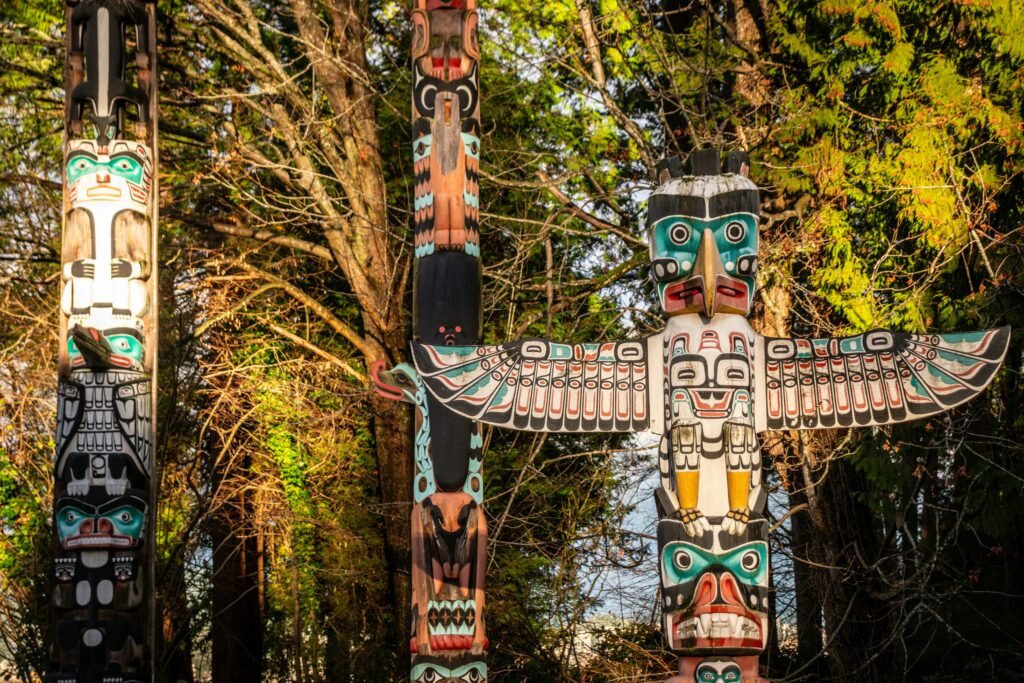
Toronto offers many opportunities to encounter First Nations, Inuit and Métis art through public installations, exhibitions, library programs, festivals, films and artist talks. Toronto Indigenous art can be encountered through many of these cultural experiences.
Engaging respectfully involves more than visiting a gallery or photographing an attractive work. It means learning who created it, identifying the artist’s Nation or community when that information is provided, understanding the context in which the work is presented and avoiding the assumption that one artwork represents every Indigenous culture.
A thoughtful starting point is to prioritize information provided by Indigenous artists, curators, knowledge keepers and Indigenous-led organizations.
Begin With the Understanding That Indigenous Art Is Not One Category
“Indigenous art” is a broad term encompassing the work of many distinct peoples, Nations, communities and individual artists.
First Nations, Inuit and Métis are not interchangeable identities. Within each are diverse histories, languages, artistic traditions and contemporary experiences.
Two artists from different Nations may use similar materials for entirely different purposes. Artists from the same community may produce work in completely different styles.
When viewing an artwork, look for information about:
- The artist’s name
- The artist’s Nation or community
- The title of the work
- The date it was created
- The materials and techniques used
- The artist’s own description
- The curator’s interpretation
- Whether the work is traditional, contemporary or combines different approaches
- The place or community connected to the work
Avoid trying to identify an artist’s background based only on visual style. Read the label, listen to the artist or consult a reliable source.
Learn About the Indigenous History of Toronto
Art becomes more meaningful when you understand the land and communities connected to the place where you are viewing it.
The City of Toronto’s land acknowledgement recognizes the traditional territory of several Nations, including the Mississaugas of the Credit, Anishnabeg, Chippewa, Haudenosaunee and Wendat peoples. Toronto is also home to diverse First Nations, Inuit and Métis communities today.
A land acknowledgement should be treated as a starting point for learning—not a complete account of local history.
Look beyond memorizing its wording. Consider:
- Which Nations have historical and continuing relationships with Toronto
- How treaties relate to the city
- How Indigenous communities continue to shape Toronto
- Why particular public artworks appear in specific locations
- How land, water and place influence an artist’s work
- Whether the artwork responds to displacement, colonialism, survival or renewal
Indigenous art in Toronto is not only a record of the past. It is also part of the city’s contemporary cultural life.
Start With the Toronto Public Library
The Toronto Public Library offers a free and accessible way to begin learning before or after visiting an exhibition.
Its Indigenous Initiatives section includes books, films, language-learning materials and public programs for Indigenous and non-Indigenous audiences.
The library’s Native Peoples Collection places particular emphasis on First Nations, Métis and Inuit peoples in Canada. You can use it to learn about:
- Indigenous art history
- Contemporary artists
- Indigenous film and media
- Beadwork and textile practices
- Sculpture and carving
- Photography
- Storytelling
- Architecture
- Indigenous languages
- Toronto’s urban Indigenous communities
Whenever possible, begin with books, films and essays created by Indigenous authors and artists. These sources allow people to describe their own work, identities and communities rather than being interpreted entirely by outsiders.
The library also maintains a calendar of Indigenous initiatives and programs, which can include workshops, documentary screenings, readings and conversations.
Explore Indigenous Public Art
You do not need to wait for a temporary exhibition. Indigenous artworks can be found in Toronto’s public spaces.
The City’s Public Art Map contains information about hundreds of works across Toronto. Search the map by artist, title or location and read the available descriptions before planning your visit.
When you encounter public art:
- Look for a plaque or interpretive sign.
- Record the artist’s name and the work’s title.
- Read the artist’s statement when available.
- Research the location’s Indigenous history.
- Consider why the work was placed there.
- Revisit the work after learning more about its context.
Do not assume every Indigenous-looking symbol was created by an Indigenous artist. Confirm the attribution through the installation information or official public-art record.
Visit the Spirit Garden at Nathan Phillips Square
The Spirit Garden is an Indigenous cultural space at Nathan Phillips Square created for teaching, learning, sharing, healing, ceremony and reflection.
It was developed by Toronto Council Fire Native Cultural Centre in partnership with the City of Toronto. The project responds to the Truth and Reconciliation Commission’s Call to Action 82 and honours residential-school survivors and children who were separated from their families and communities.
According to the City’s information about the Spirit Garden, the space incorporates works and elements representing First Nations, Inuit and Métis cultures, including:
- A limestone Turtle sculpture
- A teaching lodge
- A Métis Spirit Canoe
- An Inuksuk
- A Two Row Wampum walkway
- A Three Sisters teaching garden
- An amphitheatre
- A Tree of Peace
Approach the Spirit Garden as more than an outdoor attraction. Read the information about its purpose and artists, move through the space thoughtfully and remain aware that ceremonies or community activities may be taking place.
If part of the space is being used for a private or ceremonial purpose, observe any posted directions and do not enter simply to obtain a photograph.
Look Beyond Downtown Toronto
Indigenous art and cultural programming are not limited to major downtown institutions.
The City’s public-art collection includes works in parks, civic buildings, waterfront spaces and neighbourhood locations. For example, the City unveiled Campfire, an Indigenous-led public artwork at Humber Bay Shores created by Anishinaabe sculptor Michael Belmore in collaboration with artist and designer Herman Mejia.
Biidaasige Park also includes a developing public-art program. The park’s name means “sunlight shining toward us” in Anishinaabemowin and was selected through an Indigenous naming process.
Exploring art outside the downtown core can reveal how Indigenous artists and communities are contributing to Toronto’s waterfront, parks and changing neighbourhoods.
Our guide to exploring Toronto like a local instead of a tourist offers additional ideas for discovering the city beyond its most advertised attractions.
Attend Indigenous-Led Events
Artist talks, guided walks, demonstrations, performances and community programs can provide context that a gallery label cannot.
Toronto recognizes National Indigenous Peoples Month in June, and events take place throughout the year. The City’s Indigenous events and commemorations page lists public programming such as the Indigenous Arts Festival and National Indigenous Peoples Day activities.
Before attending, check:
- Who organized the event
- Who is speaking or performing
- Whether it is open to the general public
- Whether registration is required
- Whether photography or recording is permitted
- Whether part of the program is ceremonial
- Whether non-Indigenous attendees are invited to participate or asked to observe
- Whether admission is free
Follow the host’s guidance rather than relying on assumptions from another cultural event.
These activities can also provide an affordable way to engage more deeply with Toronto’s cultural life. See our guide to finding an affordable weekly hobby in Toronto for more ways to build regular cultural activities into your schedule.
Read the Artist’s Own Words
Whenever possible, look for an artist statement, recorded interview, exhibition essay or talk featuring the artist.
An artwork can be connected to personal memory, language, family, land, humour, political critique, experimentation or community teachings. A viewer may miss those dimensions when interpreting the work only through appearance.
Give greater weight to the artist’s explanation than to an anonymous social-media caption.
Useful questions include:
- How does the artist describe the work?
- What materials did they select, and why?
- Is the work connected to a particular place?
- Does the artist identify a specific Nation or community?
- Is the work responding to a historical event?
- Is humour, resistance or cultural renewal part of its meaning?
- Does the artist reject interpretations commonly applied to the work?
Respectful learning requires accepting that an artist may not explain every symbol, teaching or creative decision to the public.
Understand the Difference Between Appreciation and Appropriation
Appreciation involves learning about an artwork, crediting its creator and respecting the cultural context.
Appropriation can occur when someone removes cultural expressions from that context, copies them without permission or uses them for personal or commercial benefit.
Examples of potentially disrespectful conduct include:
- Reproducing an artist’s design without permission
- Turning a sacred symbol into a personal logo
- Copying ceremonial clothing as a costume
- Selling products based on an Indigenous artist’s work
- Removing an image from its original context
- Claiming a teaching as your own
- Describing all Indigenous styles as belonging to one culture
Being inspired to learn more is different from assuming you have permission to reproduce what you have seen.
If you want to share an artwork online, credit the artist and follow the institution’s photography and reproduction rules.
Ask Before Photographing
Photography rules depend on the artwork, venue and event.
A public sculpture may generally be photographed, while a temporary exhibition could prohibit photography. Ceremonies, performances, sacred items and community gatherings may have additional restrictions.
Before taking a photograph:
- Check posted signs
- Listen to announcements
- Ask event staff when uncertain
- Avoid photographing people without consent
- Do not use flash when it is prohibited
- Do not climb on or touch the artwork
- Do not obstruct ceremonial activity
- Respect requests to put cameras away
Permission to photograph does not necessarily include permission to use the image commercially.
When sharing a permitted photograph, include the artist’s name, artwork title and location if that information is available.
Avoid Asking Indigenous People to Educate You Personally
Curiosity does not create an obligation for an Indigenous artist, attendee or community member to answer personal questions.
Begin with publicly available resources. Read labels, attend talks, borrow books and listen to recorded interviews.
If an event includes a question period, ask a focused question connected to the presentation. Avoid questions that require one person to speak for every Indigenous community or explain traumatic experiences.
Instead of asking, “What do Indigenous people believe?” ask something specific, such as:
Could you explain how the location influenced this particular work?
Be comfortable with the possibility that some knowledge is private, community-specific or not intended for public explanation.
Do Not Treat Indigenous Art Only as Historical
Museums have often presented Indigenous creativity primarily through historical objects. Historical work is important, but Indigenous artists are also creating contemporary paintings, films, digital works, installations, fashion, photography, sculpture and performance.
Avoid assumptions that authentic Indigenous art must:
- Use traditional materials
- Depict nature or animals
- Look old
- Represent spirituality
- Reject technology
- Fit a recognizable visual style
An Indigenous artist does not need to satisfy an outsider’s idea of what Indigenous art should look like.
Look for contemporary programs and notice how artists engage with urban life, climate, identity, politics, popular culture and new media.
Learn How Museums Describe the Work
Pay attention not only to the artwork but also to how an institution frames it.
Ask:
- Does the label name the artist?
- Is the artist’s Nation or community identified accurately?
- Does the exhibition include Indigenous curators or advisors?
- Is the work described in the past tense even though the community is present today?
- Does the display explain how the object was acquired?
- Are Indigenous voices included in the interpretation?
- Does the institution distinguish cultural belongings from ordinary decorative objects?
You do not need specialist knowledge to notice whose voice is centred.
Institutional labels can provide valuable information, but they should not automatically replace an artist’s or community’s own account.
Approach Difficult History With Care
Some Toronto Indigenous artworks and commemorative spaces address residential schools, forced displacement, missing and murdered Indigenous women, girls and Two-Spirit people, and other forms of colonial violence.
Do not reduce these works to attractive backgrounds for photographs. Take time to understand what is being commemorated.
Respectful behaviour may include:
- Reading the complete interpretive text
- Remaining quiet in memorial spaces
- Avoiding playful poses
- Giving other visitors space
- Following ceremonial protocols
- Recognizing that the subject may be personally painful for attendees
- Learning about survival and community strength as well as harm
Indigenous art can communicate grief, but it can also express humour, kinship, resistance, love and cultural continuity. Avoid viewing every work only through tragedy.
Support Without Making the Experience About Yourself
Respectful engagement does not require demonstrating publicly how respectful you are.
Focus on:
- Listening
- Crediting artists
- Attending Indigenous-led programs
- Reading Indigenous authors
- Following community guidance
- Correcting inaccurate information
- Paying artists when attending paid programming
- Avoiding unauthorized copying
- Returning to learn more
If you make a mistake, accept the correction without becoming defensive or expecting someone else to reassure you.
Toronto’s multicultural character offers many opportunities for learning, but cultural curiosity should always be accompanied by humility. Our article about Toronto’s multicultural lifestyle discusses the wider importance of respectful participation across the city’s communities.
A Simple Checklist for Respectful Learning
Before visiting an exhibition or event, ask:
- Is the program Indigenous-led or meaningfully shaped by Indigenous contributors?
- Have I read the organizer’s visitor information?
- Do I know whether photography is permitted?
- Can I identify the artist rather than only the institution?
- Am I distinguishing First Nations, Inuit and Métis identities?
- Am I treating contemporary artists as contemporary?
- Am I prepared to listen without expecting personal instruction?
- Will I credit the artist if I share the work?
- Do I understand whether part of the event is ceremonial?
- Where can I continue learning afterward?
You do not need to know everything before attending. Respect is demonstrated by how you approach the experience and respond to what you learn.
The Bottom Line
Learning about Toronto Indigenous art respectfully begins with recognizing diversity. First Nations, Inuit and Métis artists are not members of one culture, and no individual artwork can represent every Indigenous experience.
Use the Toronto Public Library’s Indigenous collections, attend Indigenous-led programs and explore public art throughout the city. Read artists’ own words, credit their work, observe photography rules and accept that some teachings are not yours to reproduce.
The goal is not to become an instant expert. It is to build a more informed and responsible relationship with the art, artists, histories and living communities that are part of Toronto.
Note: Event schedules, exhibitions, access rules and photography policies can change. Confirm current details with the official organizer before visiting. Cultural protocols can also differ among Nations, communities, artists and ceremonies; follow the guidance provided by the people hosting the specific program or space.