
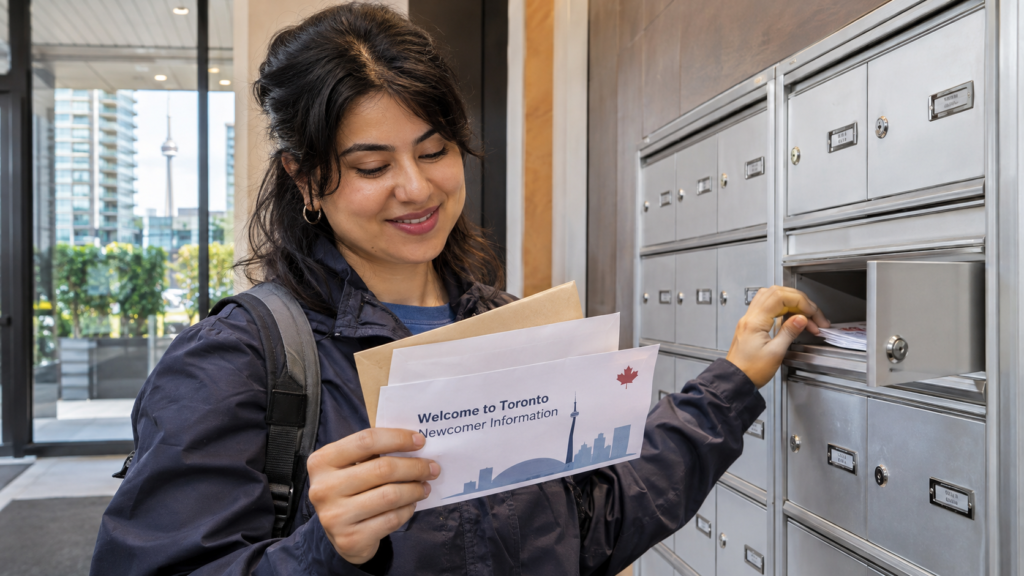
Your first Toronto address might be a relative’s house, a rented room or an apartment you have only recently moved into. Before giving that address to organizations sending important documents, check how mail actually reaches you.
A correct street name is only part of the setup. You also need the right unit information, access to the delivery point and an arrangement that will continue until your correspondence arrives.
Toronto newcomer mail delivery becomes easier when you separate three questions: What address should the sender use? Where will the letter be delivered? Who can collect it?
Confirm the Complete Address Before Using It
Ask your landlord, accommodation host or building manager to confirm the complete mailing address in writing. This is particularly useful when a rental advertisement shows only the building address.
Check the street number, street name, street direction, assigned unit number and postal code. A missing “East” or “West” can change the destination. An apartment number omitted from an application can leave the sender with an incomplete address.
Keep one checked version in a secure note so you can copy it into forms. Review the final address displayed before submitting, especially when a website automatically suggests a different version.
Do not substitute the building’s marketing name for its street address. A familiar condo name may help someone find the entrance, but the sender still needs the mailing details.
Understand Where the Apartment Number Goes
Canadian address formatting can look unfamiliar because the apartment number may appear before the street number.
For example, in “508-120 EXAMPLE ST,” 508 represents the apartment and 120 represents the building. This is an illustration of the format, not a real address to use.
Canada Post recommends a hyphen between the unit and street numbers, the provincial abbreviation and a space within the postal code. It also recommends avoiding the number sign before an apartment or street number.
When an online form provides a separate apartment field, enter the unit there and inspect the completed address. Do not accidentally enter the apartment twice.
If a form has no obvious unit field, check its instructions rather than leaving the information out. The federal Translation Bureau also illustrates an accepted format placing “APT” and the apartment number after the street name.
Check Basement-Suite Details Without Inventing a Unit
A separate entrance does not tell you whether a basement has its own recognized mailing address.
Ask whether occupants receive letters through a shared household mailbox or through an established separate delivery arrangement. Find out exactly how previous occupants addressed their mail.
Do not invent “Unit B” or add a basement designation simply because it seems descriptive. Canada Post directs people adding a suite number to an existing address to contact their municipality to register the address.
Your immediate task as a newcomer is to confirm the existing arrangement. If the landlord’s explanation is unclear, resolve it before requesting documents that would be difficult to replace.
Identify Who Controls the Mailbox
Ask to see the delivery point during your move-in walkthrough. It may be beside the front door, inside a locked lobby or in a community mailbox away from the property.
For an apartment or condo mailbox, Canada Post directs residents to the building manager or superintendent because it does not manage those mailboxes. Building access and mailbox access may therefore require separate keys or arrangements.
Test the key while the person handing it over is present. Confirm which compartment belongs to your unit and whether you can reach it outside office hours.
If you use a Canada Post community mailbox, ask for its location and compartment details. When the landlord or previous owner cannot provide the keys, Canada Post has a process for requesting them. Do not assume the nearest community mailbox serves your address.
Make a Clear Arrangement When Staying With Someone
Receiving mail at a friend’s or relative’s home requires their agreement.
Explain whose letters will arrive and ask where they will be kept. In a busy household, correspondence can easily disappear beneath flyers or be mistaken for another person’s mail.
Agree on a simple routine: the host sets your letters aside, you collect them regularly, and they notify you when something appears urgent. Include each family member who expects correspondence rather than assuming one person’s name covers everyone.
If you move out, agree on a collection arrangement with a clear end date. Avoid leaving your host responsible indefinitely for identifying important envelopes or contacting you.
Ask Temporary Accommodation About Mail Handling
Before using a hotel, short-term rental or temporary residence for important correspondence, ask whether it accepts letters addressed to guests.
Find out whether staff require your booking name, a room number or another reference. Ask what happens if a letter arrives after checkout and whether someone can collect it on your behalf.
The practical issue is timing. Accommodation that works for a week may be unsuitable for correspondence whose arrival date is uncertain.
Keep residential and mailing information accurate when completing applications. Where an organization permits a separate mailing address, ask how to enter it. Our guide to building proof of address in Toronto explains why receiving letters somewhere does not automatically make those letters acceptable evidence of residency.
Prepare for Collection Before a Notice Arrives
A delivery notice may require you to collect an item rather than receive it at home. Read the notice for the collection location, availability information and identification requirements.
Do not assume a passport alone resolves every collection situation. Canada Post’s identification guidance states that when photo identification does not show an address, additional proof of residency is needed. Check the requirements for your particular item before travelling to the collection point.
This is worth planning early if your Canadian address documents are still limited. Keep relevant records accessible, and ask about acceptable alternatives when your circumstances do not fit the usual document list.
Deal With Missing Letters Through the Sender
If an expected letter does not arrive, first check the address recorded by the sender. Ask them to read back the complete address, including the apartment number, rather than simply confirming that they have your Toronto address.
Then establish whether the item was actually dispatched and whether tracking exists. An application confirmation does not necessarily mean the document has been mailed.
Keep a short record of the dispatch date, reference number and follow-up instructions. Before requesting a replacement, ask what happens if the original later arrives.
If several unrelated senders report delivery problems, raise the shared pattern with the appropriate mailbox manager or postal support contact. Provide dates and specific examples without sharing unnecessary identification details.
Update Senders When You Move Again
A second move is common during the first months in Toronto. Keep a list of organizations that have your address so you can update them individually.
Prioritize correspondence already in progress. Ask whether changing your account profile also changes the delivery address for a document that has been ordered.
Postal forwarding should be treated as a backup with limits. Canada Post identifies mail bearing a “DO NOT FORWARD” endorsement among its exclusions, so an arrangement to redirect ordinary letters cannot replace direct updates to senders.
Save confirmation of important changes. Your first-address setup is complete when the address is correct, the mailbox is accessible and you know how to follow up if something fails to arrive.
Note: Delivery arrangements and identification requirements can vary. For a public reference on formatting apartment numbers, street details and postal codes, consult the Government of Canada’s guide to addresses on envelopes and parcels.