
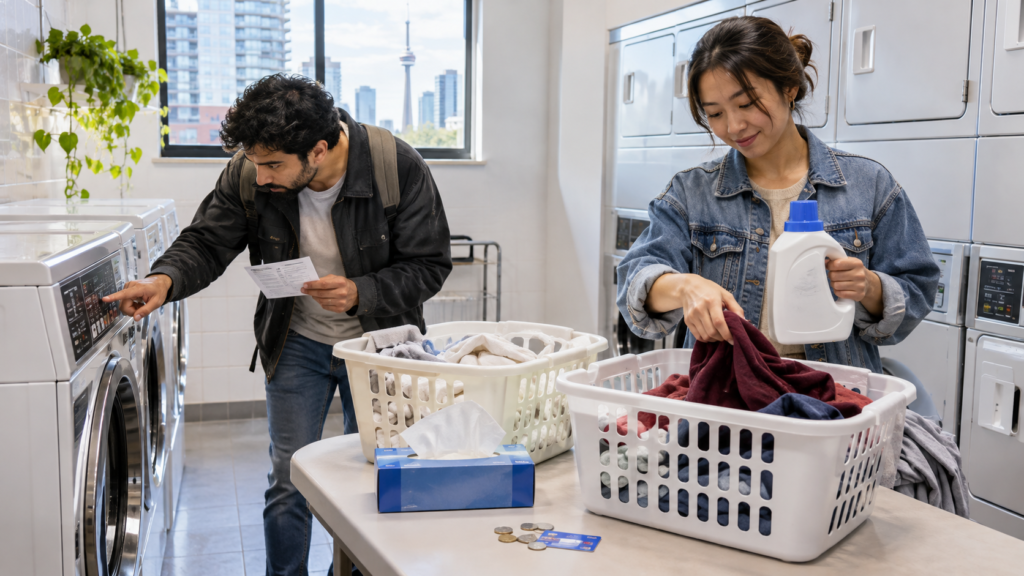
Your laundry basket is full, but the machines downstairs require an unfamiliar card, the detergent drawer has several compartments and nobody has explained when the room closes. A routine household task can take extra planning during your first weeks in Toronto.
Shared laundry arrangements differ between apartment buildings, basement rentals and temporary accommodation. Instructions from a previous home may not apply to the equipment available now.
Before your first load, learn how to access the room, pay for a complete wash and dry, and report a problem. This guide to Toronto newcomer laundry rooms covers the practical details that can prevent wasted payments and damaged clothing.
Confirm Access and Closing Arrangements
Ask the landlord, host or building manager where the laundry room is and which key or access card opens it. Check whether the return route requires the same access, particularly when the room connects to a basement corridor or another building section.
Read the posted operating hours. Find out whether closing time means the last time you can start a cycle or the time the room becomes inaccessible.
Leave enough time for washing, transferring clothes and drying. A machine’s displayed wash time does not account for waiting for an available dryer.
If you are still comparing apartments, our guide to inspecting an older Toronto rental includes questions about shared laundry equipment and its cost.
Learn the Payment System Before Loading Clothes
Look for instructions explaining whether the machines accept coins, a laundry card, an app or another payment method. Different machines in the same room may use different arrangements.
For a card system, ask:
- Where do you obtain the card?
- Is there a separate card purchase charge?
- Where can you add funds?
- Which payment methods does the loading terminal accept?
- Can you check the remaining balance before starting?
- What happens to unused funds when you move?
For an app, confirm that it belongs to the equipment operator identified in the room. Check whether mobile reception or Wi-Fi is available where you need to activate the machine.
Avoid adding a large balance before completing a successful first load. A laundry card supplied by a previous tenant may also require clarification about ownership or account access.
Calculate the Cost of Both Washing and Drying
Read the washer price and dryer pricing separately. A dryer payment may purchase a fixed period rather than guarantee that everything will be dry.
Check whether selecting a larger machine, extra rinse or different cycle changes the amount charged. Make those choices before approving payment.
Suppose a washer costs $3.50 and the dryer costs $2.50 for an initial period. Your starting cost would be $6, with more needed if suitable items require additional drying. These figures are an example, not a Toronto-wide rate.
Keep enough balance for the whole task. Discovering that the loading terminal is unavailable while your wet clothes wait in a basket creates an avoidable problem.
Sort Clothing by Care Needs
Separate items according to their care instructions, colour and fabric needs before carrying them downstairs. This makes it easier to use the room efficiently without spreading clothing across shared surfaces.
Check unfamiliar symbols rather than choosing settings by appearance alone. The federal Office of Consumer Affairs explains five main care-symbol groups covering washing, bleaching, drying, ironing and professional cleaning.
Set aside clothing that requires handwashing, professional cleaning or drying without heat. A garment that can go into a washing machine may still be unsuitable for a tumble dryer.
For your first visit, choose an ordinary load you understand. Leave bulky bedding, delicate traditional clothing and valuable garments until you know the equipment and its limits.
Match Detergent to the Machine
Read the machine’s detergent instructions before adding anything. If it requires high-efficiency detergent, use a product labelled for that purpose.
Follow the detergent’s dosing directions for the load and the machine’s instructions about placement. Do not assume that liquid detergent, powder and capsules all belong in the same compartment.
Avoid filling a drawer simply because there is space left. Extra detergent can be difficult to rinse away and does not compensate for an overloaded drum.
Keep bleach and fabric softener separate from detergent, and use them only where the clothing and machine instructions permit. If a compartment label is unclear, ask for help before pouring.
Carry supplies in closed containers. Spills on the floor or machine controls create problems for everyone using the room.
Inspect the Machine Before Paying
Check that the drum is empty and that no objects, visible residue or previous occupant’s belongings remain inside.
Look for an out-of-order notice, error message, leaking water or obvious damage. Report a problem rather than paying to discover whether the machine still works.
Read the loading guidance and leave the space the manufacturer requires. Forcing a large basket into one washer may produce a poor result and make drying harder.
Check pockets for tissues, coins, keys and other objects. Close fasteners or prepare garments according to their care instructions.
Make a note of the machine number before starting. That number becomes useful if you later need to report a failed cycle or disputed payment.
Stay Nearby for the Start and Set a Reminder
After paying, confirm that the machine actually starts. Watch for an immediate error or payment rejection before leaving the room.
Set a phone reminder based on the displayed time, allowing for any changes during the cycle. Return promptly so another resident can use the machine.
Check the building’s policy about unattended clothes. Do not assume residents may remove someone else’s laundry whenever a cycle ends. If a machine remains occupied, follow posted instructions or ask management how to proceed.
Use a clean basket for washed clothing and avoid placing it directly on the floor. Keep shared folding surfaces clear when you finish.
Check the Dryer Separately
Before transferring clothes, remove anything whose care instructions prohibit tumble drying. Choose a suitable temperature rather than using high heat automatically to shorten the visit.
Inspect the lint filter as directed. Toronto Fire Services advises cleaning the lint screen after each load and warns against using dryers with missing, loose, damaged or clogged filters.
If the filter is inaccessible or damaged, report it instead of improvising a repair.
Check the load when the paid drying period ends. If clothes remain damp, consider the load size and selected setting before purchasing more time. Persistent poor drying should be reported with the machine number.
Document Failed Cycles Before Trying Again
If payment is taken but the machine does not operate, record the time, machine number, amount and any error message. Save the transaction confirmation where available.
Use the support contact posted in the room. Ask whether payment problems go to building management or directly to the equipment operator.
Do not repeatedly pay the same faulty machine while hoping it will restart. Follow the displayed recovery instructions, and never force open a locked door.
If clothes are trapped, explain that clearly when reporting the fault. For leaks or other immediate hazards, use the building’s urgent contact procedure and keep clear of affected equipment.
Keep a Small Laundry Routine
Once the first visit works, save the useful details: room hours, payment method, usual cycle cost and support contact. Keep your laundry card with your access items and check its balance before your next visit.
Bring detergent, a clean basket and enough time to complete the task. Those simple preparations make shared laundry easier while you settle into your new home.
Note: Equipment instructions and building rules vary. Follow the directions posted on your machines and use the Government of Canada’s Guide to Apparel and Textile Care Symbols to help interpret clothing labels.