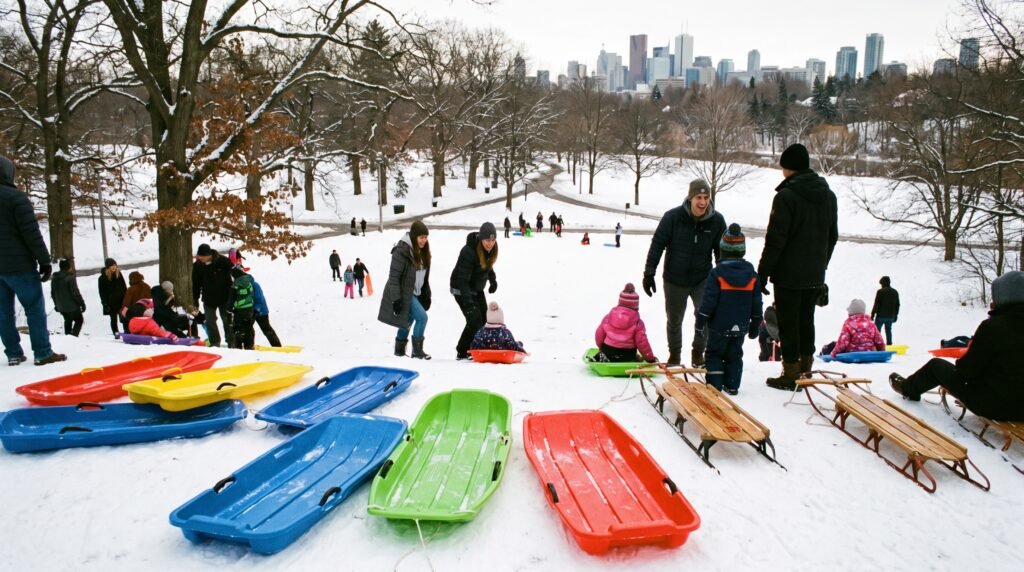
Fresh snow can make an ordinary Toronto park look like the perfect place for a sledding trip. Before heading uphill, however, take time to assess the slope, the space below it and the conditions your group will encounter.
Toronto tobogganing is easier to plan when you separate choosing a location from deciding whether it is suitable that day. A familiar hill can change after rain, freezing temperatures or heavy use. A busy slope can also present challenges that are not obvious in a photograph.
Start with current City information, then make your own observations on arrival. Be willing to change the outing if the conditions do not suit your group.
Begin With the City’s Tobogganing List
Toronto publishes a list of tobogganing locations that it inspects regularly during winter. The City warns that these hills may close when conditions are unsafe and that other slopes can contain hazards.
Use that list as your planning starting point rather than selecting a hill solely because people are sledding there.
Confirm the address and identify the intended area within the park. A park can contain several slopes with very different surroundings.
Check current notices and follow signs or barriers on arrival. A location appearing on the list does not guarantee suitable conditions throughout the winter.
Look at the Bottom Before Choosing the Top
It is tempting to judge a hill by its height. Spend just as much time looking at where a sled would finish.
The City advises checking for hazards, avoiding ice-covered areas and ensuring generous stopping space away from roads, railway lines and rivers.
Observe the whole route from a safe position. Notice whether people are gathering where sleds finish or crossing the slope on their way elsewhere.
Do not assume that a rider will stop at exactly the same point as the person before them. If the available space looks doubtful, choose another location.
A lower starting point does not resolve a hazardous stopping area.
Match the Outing to the Least Experienced Person
For a first visit, choose a setting your whole group can manage comfortably.
Consider the climb as well as the descent. Someone may enjoy sliding but find repeatedly carrying equipment uphill tiring. A child who was confident on the first run may become less comfortable as the session continues.
Avoid turning the outing into a competition over who starts highest or travels farthest. Agree that anyone can stop without needing to justify it.
If adults and children want different experiences, plan how supervision will work before separating. One adult should not be expected to watch several widely scattered riders at once.
Inspect the Sled Before Leaving Home
Set the equipment down somewhere well lit and examine it before packing.
Look for cracks, broken handles, sharp edges and loose components. Check the manufacturer’s intended use, including rider limits, rather than assuming that an extra passenger will fit safely.
Toronto recommends proper sliding equipment and cautions that inner tubes and plastic discs can be difficult to control.
Do not improvise with household objects or assume damaged equipment will last for one more trip.
Check how you will carry the sled to the park. Keep loose parts contained and avoid blocking entrances or other passengers if your journey involves public transportation.
Choose a Helmet for the Activity
The City recommends wearing a helmet for tobogganing and identifies ski helmets as an appropriate option.
Check the helmet’s intended activities and fit instructions. Toronto Public Health emphasizes matching helmets to the activity and notes that hockey helmets can also be used for tobogganing.
Fit each person’s helmet before leaving, then check it again with the clothing they will wear outdoors. It should sit securely without sliding around.
Ask about the history of a helmet you already own. Follow replacement guidance after impacts; an undamaged-looking shell does not necessarily establish that continued use is appropriate.
A helmet adds protection but does not make a hazardous slope suitable.
Prepare Clothing for Movement and Repeated Snow Contact
Think about the entire session: walking to the park, climbing, waiting and sitting in snow.
Choose clothing that allows comfortable movement and prepare spare gloves or mittens if practical. Wet hands can bring an otherwise enjoyable visit to an early end.
Secure clothing so it does not trail behind the rider. Toronto’s guidance warns against loose scarves, drawstrings and long ropes.
Check pockets before the first run. Keep keys and phones secured rather than loose where they could fall out on the slope.
Plan where bags will remain without creating an obstacle or requiring someone to retrieve them from an active sliding area.
Establish a Simple Hill Routine
Before anyone starts, agree on where to wait, where to slide and how to return uphill.
The City advises sitting or kneeling, keeping the route clear before descending, sliding down the middle and climbing up the sides. Children should have adult supervision.
Explain the routine in plain language and check that younger participants understand it. Watch how the hill is being used before joining.
If crowding makes clear separation difficult, wait or leave. Repeated near misses are a reason to reconsider the session, not something to accept as part of a popular winter outing.
Plan Breaks and the Journey Home
A successful first trip can be short. Decide on a reasonable session length and keep enough energy for the walk back.
Bring drinking water and identify somewhere appropriate to take a break. Check whether any nearby indoor facility will actually be open during your visit.
Winter access can differ from summer arrangements. Our guide to Toronto public washrooms explains why a facility shown on a map may be closed seasonally.
Allow time to return in daylight, especially when the route is unfamiliar. If you are relying on transit, check the return journey rather than waiting until everyone is cold and tired.
Keep Pets and Spectators Out of the Sliding Area
Arrange the outing so riders can concentrate on the slope.
Toronto asks visitors to leave pets at home because they may become excited and difficult to control around tobogganing.
Choose a safe observation position for anyone who is not participating. Avoid gathering at the bottom or stepping into a rider’s route for a photograph.
Take pictures from a position that does not interfere with others. A memorable family photograph is easier to arrange during a break than while someone is approaching at speed.
Reassess Conditions Throughout the Visit
Your first inspection should not be the last.
Watch for changes in visibility, crowding and the surface. Stop if the route becomes difficult to assess or your group is no longer comfortable using it.
Check in with children between runs. Fatigue, frustration or wet clothing can make continuing less enjoyable even when everyone was enthusiastic at arrival.
The City directs residents to report unsafe conditions through 311 and use 911 for emergencies.
Keep the park’s name and address accessible so you can describe your location clearly if assistance is needed.
Helpful Public Resources
- City of Toronto: Tobogganing: Listed hills and safety guidance.
- Toronto Public Health: Helmet Safety: Helmet selection, fit and replacement information.
- City of Toronto: Ice and Snow Activities: Other winter recreation options.
Note: Snow, ice, visibility and access can change quickly. Check current City information, obey closures and assess the hill on arrival. A listed location or protective equipment does not eliminate risk; postpone or end the outing when conditions are unsuitable.