You know which house is yours, but someone approaching for the first time may see several similar entrances, a dark porch or a number hidden behind a shrub.
Toronto home address numbers help visitors and responders identify the correct property. Their usefulness depends on more than whether a decorative number is attached somewhere near the door.
Before replacing a sign, check the official address, the street providing primary access and the applicable municipal requirements. Then assess whether the number is genuinely readable from the street in ordinary conditions.
Confirm the Official Municipal Address
Start with the address assigned to the property. Compare it with the number displayed outside.
An old sign, previous owner’s preference or delivery instruction does not authorize a different municipal number.
Toronto’s municipal addressing team assigns and maintains property addresses. Its guidance identifies situations that may require revised addressing, including new entrances, additional buildings and changes involving corner properties.
If records disagree, contact the City before purchasing replacement signage.
Distinguish the municipal street number from an apartment or unit identifier. Both may be needed for navigation, but they serve different purposes.
Check Which Street the Number Should Face
Toronto’s Numbering of Properties bylaw requires the appropriate municipal address number at a conspicuous, clearly visible location facing the street providing primary access to the property.
That can be important on corner lots or properties with side entrances.
Do not assume the most attractive wall is the correct location. Look at how someone approaches from the street and where the primary access is identified.
If a renovation moves the main entrance to another street, ask whether the addressing arrangement needs review. Adding a second sign may not resolve an underlying official-address issue.
Match Number Size to Property Type and Setback
There is no single size that applies to every Toronto property.
The bylaw sets minimum sizes according to setback distance and distinguishes single-family residential properties from commercial, institutional and multi-residential properties.
Before ordering numbers, establish which category applies and how the relevant distance should be measured.
A number suitable beside a door close to the sidewalk may be difficult to read on a house set farther back.
If the measurement or classification is unclear, ask the City for guidance. Avoid choosing a size solely because it fits neatly on a narrow doorframe.
Leave enough space for the entire assigned number to appear clearly.
Test Visibility From the Street
View the property from the position where an unfamiliar person would first try to identify it.
Check from more than one approach direction while remaining safely on public space. Do not stand in the roadway to assess readability.
Ask someone who does not regularly visit whether they can identify the number without being told where to look.
Notice whether neighbouring signs, parked vehicles or landscaping draw attention away from it.
A number can be large enough yet hard to locate. Clear placement helps someone find it before they begin comparing individual digits.
Review Contrast and Character Shape
Readability depends on the relationship between the number and its background.
Dark digits on a dark wall can disappear in shade. Highly decorative characters may be mistaken for other digits at a distance.
Before installing, hold the proposed number against the intended background and assess it from the normal approach point.
Check spacing as well. Digits placed too close together can look like a different number, especially when viewed at an angle.
The goal is quick recognition. Decorative choices can remain part of the design provided they do not make the address difficult to interpret.
Check After Dark
Repeat the visibility check in the evening.
Porch lighting can create glare, cast shadows or illuminate the doorway while leaving the number unreadable. A sign visible in daylight may disappear completely at night.
Toronto’s bylaw includes additional lighting provisions for specified non-single-family property categories. Confirm the rules applying to your building rather than assuming all properties have identical requirements.
For a practical review, note whether existing light reaches the number and whether approaching visitors can distinguish every digit.
If electrical changes are needed, arrange appropriate help. Do not improvise wiring to solve a signage issue.
Look for Seasonal Obstructions
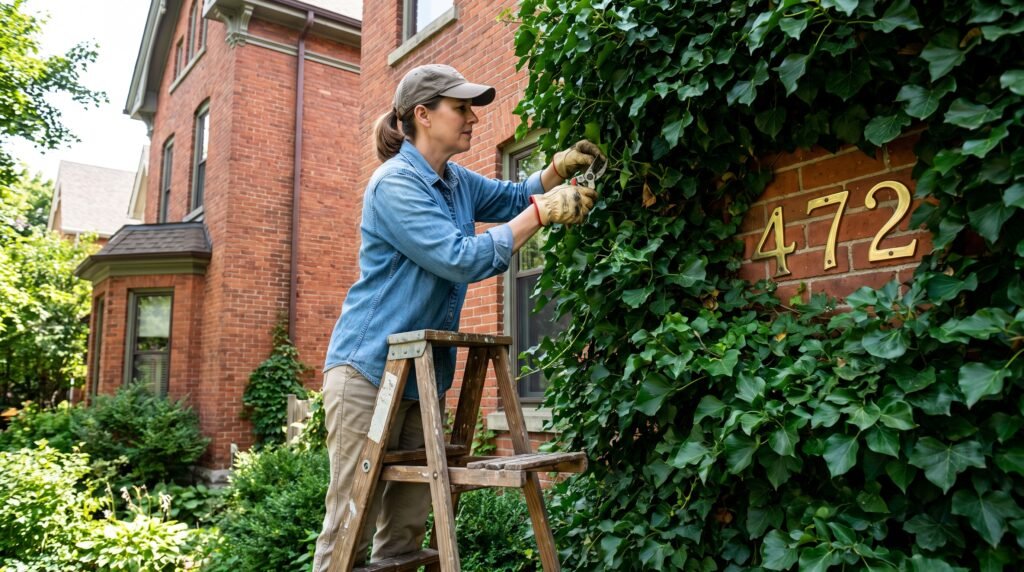
Shrubs, climbing plants, hanging baskets and temporary decorations can gradually hide a number.
Check visibility when foliage is fullest, not only when branches are bare. Review holiday decorations and seasonal items before leaving them in place for several weeks.
Snow accumulation can affect low signs or the view from the street. Observe the property after ordinary winter clearing.
Toronto Blog’s street tree guide explains why you should establish responsibility before pruning a tree that may belong to the City.
Move your own obstructing items where practical, but do not cut public vegetation merely to expose a sign without checking the appropriate process.
Avoid Conflicting Numbers Around the Entrance
Remove uncertainty caused by obsolete or inconsistent signage.
A previous number, decorative plaque or separate entrance label can confuse someone unfamiliar with the property.
Toronto’s bylaw requires removal of inaccurate or non-complying municipal addresses.
Where several units share one street address, distinguish unit labels clearly from the main property number. Ask the owner or manager about the approved arrangement before changing shared signs.
Do not create an unofficial street number for a basement entrance or backyard building. Confirm whether separate municipal addressing is required.
Coordinate Changes With the Responsible Person
Tenants should raise visibility problems with the owner or property manager before altering the exterior.
Provide photographs showing the obstruction or poor contrast and explain where the number becomes difficult to see.
In a condominium or multi-residential building, ask who manages the main address sign and entrance directory. A private change to one doorway may not solve the building-wide problem.
Request a specific action, such as clearing an obstruction, repairing missing digits or reviewing lighting.
Keep the discussion separate from delivery preferences. The official address should remain accurate even if residents use another entrance for everyday access.
Review Construction and Temporary Coverings
Scaffolding, protective sheeting and renovation materials can hide an otherwise clear number.
Before exterior work begins, ask how the address will remain identifiable throughout the project.
Any temporary arrangement should display the correct number clearly without creating hazards or conflicting with municipal requirements.
Check visibility again when work finishes. New cladding, paint or a relocated fixture may change the original sign’s contrast and sightline.
Avoid leaving the address missing while waiting for a decorative replacement. Ask about a suitable interim solution.
Report Unresolved Addressing Problems
If the issue concerns an unclear official address, multiple entrances or a property that appears unaddressed, contact Toronto’s municipal addressing staff.
The City says addressing problems affecting emergency services receive priority and directs residents to 311 to report property-address or municipal-numbering issues.
Explain the exact problem and location. Photos can help show why existing signs are confusing.
Keep any reference number and follow-up instructions. An inquiry about addressing is different from requesting a preferred number for personal reasons, so describe the practical issue accurately.
Include the Address in Household Preparedness
Make sure household members know the full address and unit number, where applicable.
A child, visitor or caregiver may recognize the building without being able to state its address confidently.
Keep the information somewhere accessible inside the home, while ensuring the exterior number remains visible. Written directions can supplement clear signage but should not become the only way to identify the property.
After changes to an official address, ask which records need updating. Replacing the exterior sign alone does not necessarily update government or organizational records.
Official Resources
Note: This article provides general information. Number size, placement and lighting requirements depend on the property and applicable bylaw provisions. Confirm uncertain measurements or addressing arrangements with the City before making changes.