
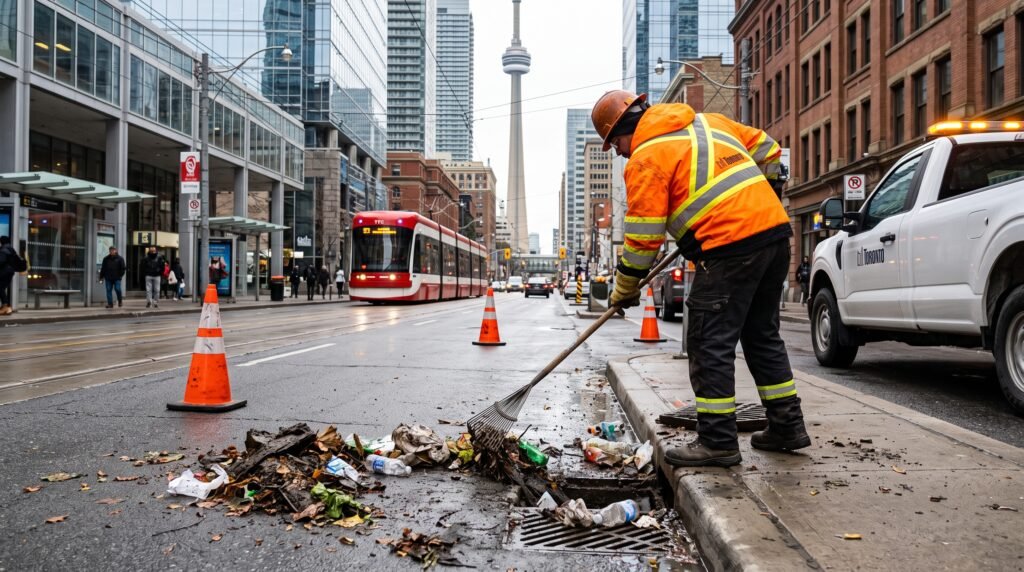
Water gathering beside a curb can look like a straightforward drainage problem. You may see leaves covering a grate, notice a puddle that remains after rainfall or find that melting snow has nowhere obvious to go.
However, reporting Toronto blocked catch basins works best when you describe the visible conditions without assuming what has failed underground. Surface debris, damaged infrastructure and an overwhelmed drainage system can require different responses.
Your most useful contribution is a clear location, an accurate description and photographs taken safely. You do not need to open a grate or investigate the chamber to make a helpful report.
Identify the Drainage Feature You Are Reporting
A catch basin collects surface runoff through an inlet or grate. Toronto’s drainage system also includes roadside ditches, culverts and maintenance holes, which have different reporting options.
Describe what you can actually see. Is there a grated opening beside the curb, a pipe beneath a driveway or a solid cover in the road?
If you cannot identify the feature, explain its shape and position to 311. A photograph can help staff understand the issue.
Avoid selecting a category based only on the word “drain.” A household floor drain backing up and a roadside grate covered with leaves are different problems.
Give a Location That Distinguishes the Exact Spot
A street address alone may not identify the affected catch basin, particularly near a corner, large property or building with several entrances.
Include the nearest address, the side of the street and a recognizable reference point. For example: “Beside the east curb, immediately north of the driveway serving number 40.”
Check that any map pin reflects the actual location. A phone may place it on the building or across the street rather than at the inlet.
If several catch basins are affected, describe each location separately in your notes. Ask 311 how to record them so the report remains clear.
Do not enter traffic to obtain a more precise measurement or photograph.
Describe the Water Before Diagnosing the Blockage
Record what the water is doing and when you noticed it.
Useful observations include:
- Water gathering during active rainfall.
- A puddle remaining after rain has stopped.
- Runoff passing over an apparently covered inlet.
- Water extending onto a sidewalk or driveway.
- Ice forming where pooled water previously stood.
Give the observation time and describe whether conditions changed while you watched.
Avoid estimating depth by stepping into the water. If you cannot see the grate, say that it is obscured rather than assuming it has disappeared.
A factual description helps staff assess the report without relying on an unconfirmed explanation.
Distinguish Surface Debris From Grate Damage
Look from a safe position for visible leaves, litter or snow covering the inlet. Separately, note whether the grate appears loose, broken, sunken or missing.
Toronto directs residents to report damaged or missing grates and avoid travelling over a grate that appears unstable.
Make the physical hazard explicit in your report. “Grate appears displaced, leaving an opening beside the curb” communicates a different concern from “leaves cover the intact grate.”
Do not test whether a cover moves or attempt to put it back. Keep others away where you can do so safely, and contact the appropriate service.
Use 911 if there is an immediate emergency threatening life or safety.
Take Photographs That Explain the Situation
If safe, take one wider photograph showing the location and another showing the visible issue.
The wider image can include an address marker, intersection or driveway. The closer image may show debris, the position of a grate or the edge of pooled water.
Stay on stable ground and outside traffic. A zoomed photograph is preferable to approaching an obscured opening.
Keep the original images and note when they were taken. If you photograph the area again later, label the new images so the sequence is understandable.
Do not delay an urgent report while trying to produce perfect evidence. An accurate description can still be useful without photographs.
Clear Surface Debris Only When It Is Safe
The City asks residents to help keep nearby catch basins clear of leaves and debris where safe, while advising people not to approach or touch flooded areas.
Treat those conditions seriously. A catch basin surrounded by traffic, hidden beneath water or covered by unstable ice is not a suitable place for an informal cleanup.
Limit any safe assistance to accessible surface material. Do not remove the grate, reach into the chamber or push tools through the openings.
Move collected debris to the appropriate disposal stream rather than leaving it where the next rainfall can carry it back.
If the task requires entering the roadway or handling sharp or unknown material, report it instead.
Use the Service Request That Matches the Concern
Toronto provides catch-basin reporting routes for debris, blockage or flooding, and maintenance.
Choose the closest match and explain any additional conditions in the description. Contact 311 if the categories do not fit what you are seeing.
Save the confirmation number, submission date and information you provided. If staff request clarification, use the same location description and photographs.
Avoid assuming that a report guarantees a particular repair or attendance time. Ask what updates are available and how to report a significant change.
If water begins affecting a property after your initial submission, explain the new circumstances when following up.
Check Whether the Drainage Is on Private Property
Not every catch basin visible from the street belongs to the municipal drainage system.
Toronto distinguishes its responsibility for drainage in the public right-of-way from owners’ responsibility for private drainage, including driveway, backyard and private-property catch basins.
For a condominium driveway or shared parking area, notify management promptly. Give the location and explain which access routes or buildings are affected.
If responsibility is unclear, ask rather than deciding solely from proximity to the curb. Property boundaries and drainage connections may not be obvious.
Do not arrange alterations to shared drainage without the appropriate authorization.
Record Recurring Ponding as a Pattern
If water repeatedly collects in the same place, keep a short log.
Record the date, weather, approximate duration and whether the inlet was visibly covered. Include previous request numbers and note any work you observed.
A recurring problem deserves more detail than “it floods whenever it rains.” For example, explain whether water clears soon after rainfall or remains into the next day.
Toronto notes that streets can carry stormwater exceeding sewer capacity and that temporary ponding is expected during major storms.
That context does not establish the cause at your location. Report the pattern and let the appropriate staff assess it.
Reassess During Snowmelt and Falling Temperatures
A drainage concern can change when daytime melting is followed by freezing conditions.
The City advises reporting blocked catch basins and ponding on roads or sidewalks to 311. Its stormwater guidance also addresses keeping drainage paths clear during snowmelt where safe.
Mention any ice affecting pedestrian access in your report. Explain whether the water crosses an entrance or a frequently used walkway.
Avoid moving snow into the road or creating a channel that redirects water toward another property.
For a separate concern involving snow left across a driveway entrance, our guide to Toronto driveway windrows covers the checks to make before reporting missed clearing.
Keep Contaminants Out of the Inlet
A catch basin is not a disposal point for unwanted liquids or debris.
Toronto’s stormwater guidance explains that catch basins collect rain and melted snow, with stormwater discharged into waterways without treatment through storm-sewer outfalls.
Do not pour cleaners, paint, oil or other substances into the opening to address a blockage.
If you notice an unusual discharge, odour or suspected dumping, describe what you observed to 311. Avoid touching unknown material or attempting to identify it through close inspection.
Helpful City Resources
- Toronto: Ditches and Catch Basins: Drainage features, reporting options and maintenance guidance.
- Toronto: Managing Stormwater: Rainfall and snowmelt preparation.
- Toronto 311: Municipal service requests and follow-up information.
Note: Visible ponding does not establish the cause of a drainage problem or who owns the affected infrastructure. Report observations accurately, stay away from flooded areas and damaged grates, and confirm responsibility before arranging work.