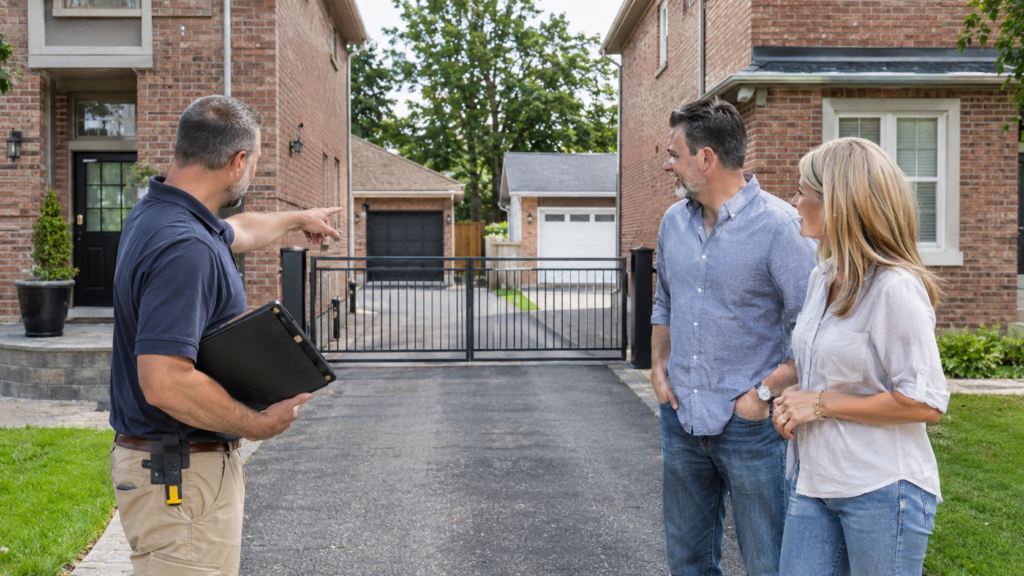
A driveway gate can seem like a straightforward way to improve privacy or control access to a rear yard. On a shared driveway, however, the proposed gate may affect someone else’s ability to reach parking, a garage or another part of their property.
Before ordering a gate for a home in Toronto’s York area, establish what land is involved and who has rights to use it. The practical design comes after those questions about York shared driveways.
A neighbour’s verbal agreement, an existing fence or a contractor’s site visit should not be treated as a complete answer. Review the property records, check Toronto’s requirements and work through how the gate would operate for everyone entitled to use the driveway.
Identify What “Shared Driveway” Means
The phrase can describe different arrangements.
A driveway might cross two properties, sit mainly on one property or provide access to several homes. Its appearance does not establish the legal arrangement.
Start with your purchase documents, available survey and title information. Note which properties use the driveway and what they access through it.
Ask a real estate lawyer to explain any easement, right-of-way or other relevant agreement. The wording matters: access rights may apply to a particular area and purpose.
Avoid assuming that the paved surface represents the legal access corridor. A gate placed outside the visible wheel tracks could still interfere with the rights that need to be preserved.
Obtain the Relevant Title Documents
Ontario’s land registry contains official property ownership records and other legal interests. Current and historical records can be searched through OnLand, although interpreting them may require professional assistance.
A parcel register can identify registered documents, but the underlying document may be needed to understand the actual access terms.
Before buying records yourself, ask your lawyer what is required. You may need documents relating to both your property and the neighbouring property.
Useful questions include:
- Which land benefits from the access right?
- What area is affected?
- What use does the wording permit?
- Are gates or obstructions addressed?
- Are maintenance arrangements recorded?
- Would any proposed change require further legal documentation?
Do not interpret the absence of a familiar phrase as proof that no access issue exists.
Confirm Boundaries Before Choosing Post Locations
A fence, garden edge or old paving joint may not accurately identify a property boundary.
Use an appropriate survey and obtain advice from an Ontario Land Surveyor where the proposed location is uncertain. Ask how the boundary and any relevant access corridor should be identified for the design.
Marking a post “on my side” does not resolve whether the gate leaf, hinges or foundations affect another person’s land or access.
Give the installer a plan showing the confirmed locations. Include the gate in both its open and closed positions, not just the posts.
If the boundary remains disputed, resolve that issue before excavation. Moving installed posts can be costly and may damage the driveway surface.
Check Toronto Fence Requirements
York is within the City of Toronto, so begin with Toronto’s fence rules.
The City explains that permitted fence height depends on the property type and location. Its guidance also requires open-fence construction near driveway entrances to preserve views of the boulevard or highway.
Ask Municipal Licensing and Standards how the rules apply to your proposed gate, posts and adjoining panels. Provide a sketch with dimensions, materials and the distance from the street.
Do not assume that a gate’s decorative design or open bars automatically satisfy every requirement. Check any other applicable approvals before ordering.
Municipal compliance also does not settle private access rights. These questions need to be considered separately.
Discuss Access With Everyone Affected
Show the proposal to each affected owner before committing to construction.
Explain where the gate would sit, how it would open and what daily access would involve. If neighbouring properties are rented, ask how residents and authorized visitors would use it.
Discuss realistic situations:
- One household leaves early while another is asleep.
- A resident loses a key or remote.
- A delivery vehicle needs temporary access.
- A tradesperson attends while the owner is away.
- The gate fails during freezing weather.
A design that depends on someone being home to unlock it may be impractical.
Have a lawyer advise on any agreement needed. A casual exchange of messages may not adequately address continuing rights, future owners or responsibility for repairs.
Measure the Clear Opening and Movement Space
Ask the installer to specify the usable opening after posts, hinges, latches and stops are fitted.
The nominal gate width may differ from the space available for a vehicle. Consider mirrors, turning movements and the approach to rear parking.
For a swinging gate, establish where the leaf travels and rests. For a sliding gate, identify the space required alongside the opening and any track or support arrangement.
Check pedestrian movement too. People carrying groceries, using mobility equipment or moving bins should have a workable route.
Do not reduce the design to whether one current car can squeeze through. Review the documented access requirements and ordinary permitted use.
Plan for Locks, Power Failure and Safe Operation
If the gate will be locked, establish how each authorized user gets access independently.
Clarify the number of keys, remotes or app permissions needed and how replacements are handled. Confirm how access is removed when a resident moves out.
For an automated gate, ask a qualified installer about obstruction protection, manual release, maintenance and the response to a power failure. Obtain instructions for everyone expected to operate it.
Avoid choosing an arrangement that requires users to stand in traffic or enter the moving gate’s path.
Also ask whether the proposal affects any required emergency access or exit route. Obtain appropriate guidance rather than assuming a manual release answers every access concern.
Prepare for Snow, Drainage and Waste Collection
York winters can change how a gate operates.
Ask how snow and ice will affect hinges, tracks, latches and opening clearance. Decide where cleared snow can go without blocking the shared route.
Review how the gate interacts with surface drainage. Posts, tracks or new paving should not be used to improvise changes to water flow.
Our guide to sustainable living in Toronto discusses responsible household practices, including keeping waste and chemicals out of drains and outdoor spaces.
Confirm how bins reach the collection point. Do not assume that a waste-collection crew or other service provider will unlock a private gate or change its usual procedure.
Arrange Utility Locates Before Excavation
Gate installation may involve digging for posts, foundations or electrical connections.
The person responsible for excavation should arrange the required utility locates and review all responses before work starts. Ontario’s locate guidance also requires checking that the paperwork matches the ground markings and remains valid.
Ask the contractor who will handle this process and whether private underground equipment needs additional investigation.
Do not use an old project’s markings or assume a shallow post hole is exempt. Keep the locate documentation available to the people carrying out the work.
Put Costs and Maintenance in Writing
Agree who pays for installation, electricity, routine servicing and unexpected repairs before accepting a quotation.
Separate shared costs from features requested by one household. Also discuss damage caused by a vehicle, snow-clearing equipment or misuse.
Ask the contractor for a written scope covering materials, dimensions, site preparation, controls, restoration and warranty terms.
For a dispute about boundary-fence location or costs, Toronto states that it does not determine those matters for neighbours. The City also notes that most of Ontario’s Line Fences Act does not apply in Toronto.
Seek appropriate advice before assuming you can install first and require someone else to contribute afterward.
Pause If the Access Question Remains Unresolved
A gate should be ordered only after the legal arrangement and practical operation are understood.
If a neighbour objects, identify whether the disagreement concerns boundaries, access, design, operation or payment. Different questions may require different professional help.
Keep drawings, correspondence, title documents and written advice together. Where appropriate, mediation may help neighbours discuss practical arrangements, while legal advice can address the underlying rights.
The goal is a proposal that can be assessed before money is spent and the driveway is altered.
Note: Shared-driveway rights and gate requirements depend on the property documents, location and proposed design. Obtain legal and surveying advice where needed, and confirm municipal requirements before installation. For a helpful public reference, see the City of Toronto’s fence guidance.