
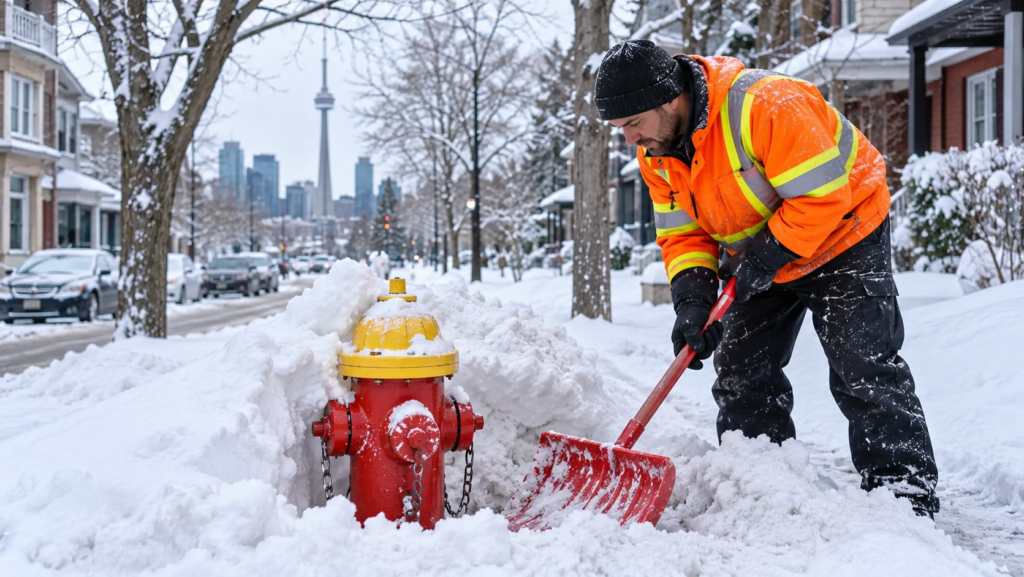
A hydrant can disappear into a snowbank over several storms. You might still see its top or a nearby marker, yet the space around it has become packed with snow from a driveway, sidewalk or passing plow.
Toronto snow-buried fire hydrants need more attention than a quick check for visibility. The City requires clear space around them, and the responsibility can apply even when a hydrant stands on City property beside your home. Before the next snowfall, identify the nearby hydrant and decide where your household’s snow can go without blocking it.
Check the Space Around the Hydrant
Toronto requires hydrants to remain visible and unobstructed, with at least 1.2 metres of space around them. The City’s guidance identifies snow, trees and other vegetation as obstructions that must be kept clear. Seeing the top of the hydrant above a snowbank does not establish that the required space is available.
Look at the surrounding area from a safe position. Has snow been piled against one side? Is the hydrant sitting in a narrow hole between banks? Are bins or other objects occupying the space you cleared?
Check the whole surrounding area rather than digging a small opening directly in front. If the snow is too compacted to remove safely, contact the responsible property manager or ask 311 for guidance instead of trying to force your way through it.
Understand Who Needs to Keep It Clear
The City says that if a hydrant is on your property, or on City property adjacent to yours, you are responsible for ensuring it stays visible and unobstructed. A hydrant on the boulevard therefore needs attention even though it is outside your lawn or fence.
For a detached home, put the hydrant on the household’s winter checklist. In a rental building, condominium or commercial property, ask management who checks it and who arranges clearing.
If several people share snow-clearing duties, name the task explicitly. “Clear the front” can mean different things to different people. A simple instruction such as “Check the hydrant after the sidewalk and driveway are finished” makes the expectation easier to follow.
Choose a Snow Storage Area Before Shovelling
Walk through where you normally put driveway and walkway snow. A convenient pile can gradually spread toward the hydrant, particularly when later snowfalls leave less room.
Choose another suitable place on the property before the pile becomes difficult to move. Give the same instruction to anyone who helps with clearing, including a contractor, neighbour or visiting family member.
Toronto prohibits pushing snow from private property onto sidewalks, roads or bike lanes. Moving a hydrant obstruction into one of those spaces creates another access problem.
Consider where the snow will settle as well as where the first shovel-load lands. Leave enough room to keep using the chosen storage area through more than one storm, and reassess it when banks grow.
Include the Hydrant in Contractor Instructions
If you hire snow-clearing help, point out the hydrant before work begins. Ask whether keeping its required clearance is included in the agreed scope and identify where removed snow should be placed.
Photos taken before heavy snowfall can help explain the layout. Show the driveway, sidewalk, hydrant and intended snow-storage area together rather than sending a close-up of the hydrant alone.
Ask who to contact if a return visit is needed. A driveway can be cleared successfully while snow remains around the hydrant, so inspect both before treating the visit as complete.
Keep the instructions with the rest of your winter maintenance arrangement. That way, a substitute crew can follow them without relying on a conversation with the usual operator.
Recheck After Snow Moves or Refreezes
A cleared area can fill again after another snowfall, drifting or nearby snow-clearing work. Check it as part of your normal inspection of the property after a storm.
Pay particular attention when a new bank forms along the curb. From a window, you may see the hydrant’s upper section without noticing that the lower area has filled.
Thawing and refreezing can also make previously loose snow harder to remove. Address manageable accumulation before it becomes a solid bank, provided you can work safely.
Do not enter a traffic lane or stand near operating snow-clearing equipment to inspect the hydrant. If reaching it requires unsafe access, describe that problem when contacting management or 311.
Report Leaks Separately From Snow Obstructions
Water around a hydrant is a different concern from snow piled against it. Toronto Water identifies water flowing from the hydrant, or from the ground directly around it, as a reason to start a service request through 311.
Describe what you can actually observe. For example: “Water appears to be flowing from the ground beside the hydrant, and the nearby pavement is icing over.”
Do not assume that every wet patch comes from the hydrant; melting snow may also be present. Explain the location and visible conditions so staff can assess the report.
Leave caps, valves and other hydrant components alone. Snow clearing is not an opportunity to test whether the hydrant works or attempt a repair.
Give a Location That Staff Can Find
A useful report identifies the nearest address or intersection, which side of the street the hydrant is on, and what is blocking access.
Distinguish between a hydrant that is partly visible in loose snow and one enclosed by a tall, compacted bank. Mention any nearby traffic, ice or equipment that makes approaching it difficult.
If you can take a photograph safely, include enough surroundings to show the location. Keep any service-request number so you can follow up on the same issue.
For a fire or another immediate emergency, call 911. Routine questions about clearance or municipal maintenance belong with 311 rather than the emergency line.
Keep the Check on Your Winter Routine
Pair the hydrant check with a task you already do, such as inspecting the front walkway after snowfall. That makes it less likely to be forgotten between major storms.
Check visibility, surrounding clearance and where the next round of snow will be stored. If someone else is taking over the property’s winter maintenance, show them the hydrant and explain the arrangement.
The City states that, after notifying an owner about inadequate clearance, it may remove the obstruction and recover the removal costs from the owner. Keeping the area clear before a notice arrives avoids leaving the problem unresolved.
For broader household preparation during severe winter weather, our guide to creating a Toronto emergency contact plan explains how to organize the people and information you may need if normal routines are interrupted.
Note: Follow current municipal instructions and avoid clearing work that puts you near moving traffic or equipment. See the City of Toronto’s Fire Hydrant: Obstructions & Use guidance for the clearance requirement and related reporting resources.