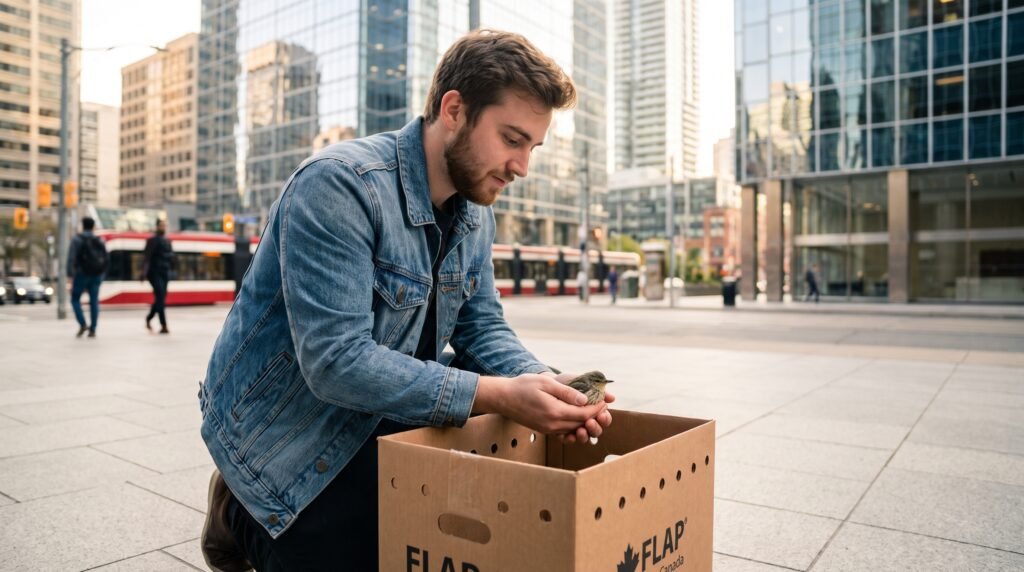
A bird lying below a window can stop an ordinary Toronto walk in its tracks. You may be unsure whether it is injured, what happened or who should be contacted.
Toronto bird collision reporting involves two different tasks: requesting assistance for a bird that may need help and documenting an observation that can contribute to collision monitoring. Completing a database entry should not be treated as a request for someone to attend.
You do not need advanced bird-identification skills to provide useful information. An accurate location, a clear account of what you observed and an honest description of uncertainty are practical starting points.
Request Help Before Completing a Detailed Report
If a bird appears injured, prioritize obtaining appropriate assistance over filling in a monitoring form.
The City’s injured-wildlife guidance provides a reporting route for birds showing signs of injury or trauma. Its Lights Out Toronto page also directs people to wildlife assistance following a window collision.
Explain where the bird is and what you can observe without moving closer unnecessarily. Mention immediate hazards such as traffic, an opening door or nearby pets.
If you are uncertain about handling the bird, seek instructions first. Do not enter a roadway, climb a barrier or put yourself at risk to reach it.
Keep the assistance request number or relevant contact details separate from your observation notes.
Record the Exact Finding Location
A building address may identify an entire block or a complex with several entrances. Add enough detail to distinguish the place where the bird was found.
Useful location notes might include:
- The street address or nearest identifiable building.
- Which side of the building you were beside.
- A nearby entrance, courtyard or intersection.
- Whether the bird was on the sidewalk, pavement or another surface.
- A map pin checked against the actual location.
For example, “outside the west-facing entrance beside the bicycle racks” is more informative than “near an office downtown.”
Check your phone’s map position before submitting it. If the suggested pin is wrong, correct it rather than assuming location services have identified the spot accurately.
Separate the Finding Time From the Collision Time
Record the date and time you found the bird. If you witnessed the impact, note that separately.
Finding a bird in the morning does not establish that the collision occurred that morning. Similarly, hearing a sound without seeing the impact leaves some uncertainty about what happened.
A useful note might say: “Found at approximately 8:20 a.m.; impact not witnessed.”
If another person tells you when the bird appeared, identify that information as their account. Keep it separate from what you observed yourself.
This approach makes your report easier to interpret without adding a level of certainty the evidence does not support.
Describe What You Saw Before Naming a Cause
Write a brief factual account while the details are fresh.
Distinguish between seeing a bird strike glass, hearing a suspected impact and finding a bird near a building afterward. A bird’s position may be relevant, but it does not allow you to reconstruct every part of the event.
Describe visible circumstances rather than diagnosing injuries. “Standing but not moving away” records an observation. “Recovered from concussion” makes a medical conclusion you may not be able to support.
If you leave before assistance arrives, record when you last saw the bird and its location at that time. Do not report an outcome you did not observe.
Take Photographs Without Delaying Assistance
When safe, a photograph can preserve details that are difficult to describe later.
Consider taking one image showing the bird and another showing the surrounding location. The wider image may help distinguish an entrance or section of a building.
Keep a respectful distance. Do not reposition a bird, open its wings or chase it for a clearer identification photograph. Avoid interrupting someone who is following wildlife-care instructions.
Retain the original images so the date and other available information remain accessible. Before sharing publicly, check whether the photograph includes identifiable people, residential interiors or other unnecessary personal details.
Documentation should support the report without becoming the reason assistance is delayed.
Leave the Species Uncertain When Necessary
You can provide a useful account without confidently identifying the bird.
Describe features you can see: approximate size, overall colouring, bill shape and distinctive markings. If your identification is tentative, say so.
Avoid choosing a species merely because it is the closest match in a quick image search. Photographs taken at an awkward angle can make identification difficult.
Our guide to Toronto birdwatching for beginners explains how observing several features produces a stronger description than relying on colour alone.
If a reporting form provides an unknown or uncertain option, use it where appropriate. Follow the form’s guidance if you cannot complete a required field accurately.
Understand What a Monitoring Submission Does
The Global Bird Collision Mapper, created by FLAP Canada, accepts reports of bird-building collisions and displays records through an online map. Its published information says an account is optional, while an account allows contributors to manage their reports.
Read the current submission instructions and privacy information before entering details.
Check the location, date and description before submitting. Include photographs where the platform allows them and where they add useful evidence.
Keep a copy of your notes. If you later learn that a detail was incorrect, use the platform’s correction process or contact its administrators.
A monitoring record contributes information; it does not establish that an animal-care response has been arranged.
Coordinate With Other Witnesses
Several people may notice the same bird. Before submitting separate records, ask whether someone has already reported that particular observation.
One person can request assistance while another records the location and photographs. Agree on who is completing each task so nobody assumes that someone else has acted.
If you are unsure whether an existing report concerns the same bird, describe the uncertainty rather than making an unsupported decision.
For an organized monitoring activity, follow the coordinator’s recording method. Consistent notes are easier to reconcile than several different versions shared across messages and social posts.
Tell Building Management What You Observed
Where appropriate, send management a concise account of the location, date and circumstances. Include a useful photograph rather than a long speculative explanation.
Ask whether staff have a procedure for reporting collisions and whether previous incidents have been recorded.
The City’s Lights Out Toronto guidance identifies both lighting and glass as relevant to prevention. It encourages reducing unnecessary nighttime lighting and describes measures that make glass more visible to birds.
Raise these questions with the person responsible for the building. Do not alter shared windows, access restricted areas or switch off lighting required for safety.
A specific observation gives management something concrete to investigate.
Follow Wildlife Instructions Rather Than Testing Recovery
Do not try to determine whether a bird has recovered by making it fly or repeatedly approaching it.
The City’s collision guidance advises minimizing handling and not giving the bird food or water. It provides instructions for temporary containment and contacting wildlife assistance.
Follow current advice for the situation, particularly if the bird’s size, behaviour or condition makes handling unsafe.
If the bird moves away before assistance arrives, update the relevant contact with what you actually saw. Movement alone should not become an unsupported claim that there was no injury.
Your most useful contribution is accurate information combined with appropriate care.
Helpful Public and Conservation Resources
- City of Toronto: Lights Out Toronto: Collision guidance and prevention measures.
- City of Toronto: Orphaned and Injured Wildlife: Information on reporting wildlife that needs assistance.
- Global Bird Collision Mapper: A conservation platform for documenting bird-building collisions.
Note: A collision-monitoring submission is separate from an injured-wildlife assistance request. Follow current City and wildlife-professional instructions, avoid unnecessary handling and record uncertainty honestly. Never put yourself at risk to obtain a photograph or reach a bird.