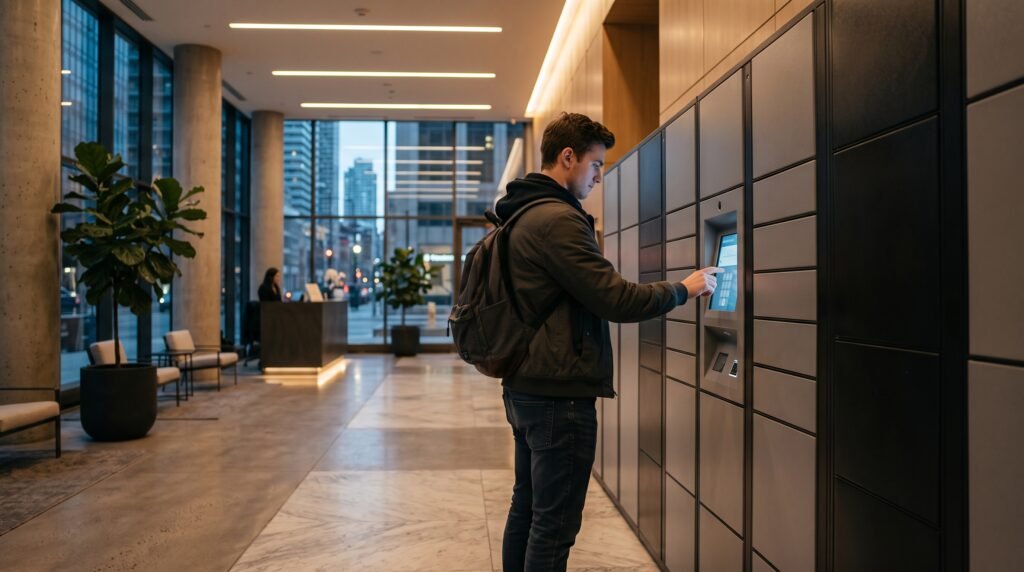
A parcel locker can make deliveries easier to collect, but its usefulness changes when every compartment is occupied. A courier may leave an oversized box with the concierge, place it in another storage area or follow a different procedure altogether.
For residents, the important question is what happens between delivery and collection when the usual locker process cannot be used.
A March 2026 Reddit discussion about Toronto condo deliveries highlighted this problem. Residents described different overflow arrangements, including packages left in mailrooms and parcels stored in locked rooms with separate notifications. These are individual experiences, not rules applying to every building.
Before relying on Toronto condo parcel lockers, confirm your building’s procedure for the exceptions.
Find Out Where Overflow Packages Go
Ask management where parcels are stored when lockers are full or a package does not fit.
The answer should identify a location and a collection process. “Security handles it” leaves several questions unresolved: Is the parcel logged? Is the storage area locked? Who releases it?
Also distinguish between the building’s intended procedure and what couriers actually do. A designated overflow room is only useful if deliveries reach it.
Ask whether packages may be left outside unit doors and whether that requires your authorization. If you prefer another arrangement, find out which instructions the building can realistically accommodate.
Separate Oversized Parcels From Full-Locker Deliveries
A locker can have available compartments while still being unable to accept your particular package.
Long, heavy or unusually shaped boxes may require different handling. Ask whether the building accepts them, where they are placed and whether staff can assist with collection.
Do not assume a concierge will move a large item to your unit. Clarify handling limits before ordering something you cannot carry independently.
For furniture, appliances or other substantial deliveries, ask whether a separate booking is necessary. Ordinary parcel storage should not be treated as approval for a delivery that needs elevator coordination or additional access.
Toronto Blog’s guide to furnishing an apartment without a car can help you think through the journey from delivery point to home.
Confirm How Overflow Notifications Work
A locker notification usually identifies a compartment or provides access instructions. An overflow parcel may generate a different message—or require manual contact.
Ask whether the building sends an email, text, app notification or concierge message for packages stored elsewhere.
Check that management has your current name, unit number and contact details. If several people live in the unit, ask whose account receives alerts.
Clarify whether every package is recorded individually. Two parcels arriving together may not produce two separate notifications.
If an alert says only “package received,” ask how to tell whether it is in a locker or requires staff assistance. Clear instructions prevent unnecessary searching through shared areas.
Check Collection Hours and Access
A parcel stored in a locked room may only be available when authorized staff are present.
Ask about evening, overnight and weekend collection. If you work irregular shifts, explain the times you normally return home.
Find out what happens when the concierge steps away or a different employee covers the desk. A consistent handover process can prevent a package from becoming difficult to locate.
Also ask what identification is required and whether someone else can collect on your behalf.
Arrange any authorization before travelling. Sharing a locker code may not be the accepted method for releasing a parcel from staffed storage.
Review Pickup Deadlines and Any Charges
Ask how long packages may remain in lockers and overflow storage.
Check whether the collection period starts when the courier delivers, when staff record the parcel or when the notification is sent. Those times may differ.
If a charge or other consequence applies, request the written policy and an explanation of how it is authorized and calculated. Do not assume another building’s deadline or fee applies to yours.
Ask what happens after the deadline. The package might be moved, returned or handled through another procedure.
For an absence, discuss arrangements in advance. A holiday or business trip should not leave management guessing whether you intend to collect a parcel.
Understand What “Delivered” Actually Establishes
A courier’s delivery confirmation may show that a parcel reached the property without showing that it entered the building’s storage system.
Compare the photograph, timestamp and location with the building’s records.
A picture of the lobby is different from a record showing that staff accepted the package. Likewise, a locker notification should correspond with the actual parcel, not merely an empty compartment.
Keep the tracking information until you have collected and checked the delivery. If there is a discrepancy, ask the courier or sender to clarify the handoff while the details are still available.
Describe what you know rather than immediately concluding that theft occurred.
Check for Misrouting Before Reporting a Loss
If the parcel is missing, start with the places your building uses.
Ask staff to check the overflow room, oversized-item area and any recent storage relocation. Confirm whether the parcel was logged under another household member or an incorrect unit number.
Do not enter restricted rooms or search packages belonging to other residents.
If a locker opens but contains the wrong item, leave the situation intact where practical and contact the responsible staff. Avoid distributing another person’s parcel yourself unless management provides clear instructions.
Record the notification time, compartment information and what you observed. This helps distinguish a loading error from an unrelated delivery problem.
Create a Short Missing-Parcel Timeline
Once the ordinary checks are complete, organize the facts.
Include:
- The tracking number and expected item.
- The courier’s delivery time and photograph.
- Any building notification.
- When you attempted collection.
- Which storage areas staff checked.
- The names or roles of people you contacted.
Ask management to preserve relevant records and review available footage promptly. Do not assume that footage exists, covers the right location or will remain available indefinitely.
Keep the request narrow: identify the likely delivery window and storage area.
Avoid posting another resident’s name or unit number publicly based on suspicion. A factual report is more useful than an accusation.
Distinguish Investigation From Access to Records
Asking management to investigate a missing parcel is different from demanding copies of footage or records identifying other residents.
The Condominium Authority of Ontario explains that eligible owners, purchasers and mortgagees can request corporate records, but access has statutory limits. Some records containing information about specific units are exempt.
Tenants seeking a formal records request should discuss that route with their landlord, according to CAO guidance.
Do not assume that reporting a loss entitles you to every camera recording or another resident’s personal details.
Ask what findings management can share and whether it will provide relevant information to police if required.
Use the Appropriate Reporting Route
If the circumstances indicate theft, check Toronto Police Service’s current reporting options.
TPS provides online reporting for certain non-emergency theft incidents, subject to its eligibility requirements. Its non-emergency number is 416-808-2222. Emergencies and crimes in progress require the appropriate emergency response.
Provide the facts you have gathered and distinguish confirmed information from assumptions.
Keep any report number with your correspondence. Contact the sender about its investigation process as well, but do not assume that filing a police report guarantees replacement or reimbursement.
Management’s search, a courier inquiry and a police report serve different purposes.
Raise Repeated Overflow Problems Constructively
If packages routinely spill into unsecured areas, document the pattern.
Note dates, the storage location and whether notifications worked. Remove visible personal information from photographs before sharing them unnecessarily.
Ask management or the board to clarify the procedure before proposing a new system. Improvements might involve better logging, clearer signage, consistent staff handovers or a defined collection process.
A useful request is specific: “When lockers are full, can residents receive a message identifying the secured overflow location and collection hours?”
That gives the building a practical issue to address without assuming a particular product is the solution.
Helpful Public Resources
- Condominium Authority of Ontario: Corporate records
- CAO: Who can request condominium records
- Toronto Police Service: Online reporting
Note: This article provides general information. Parcel acceptance, storage, collection deadlines and access arrangements vary by building. Confirm your condominium’s written procedures; locker installation alone does not establish responsibility for a missing delivery or guarantee reimbursement.