
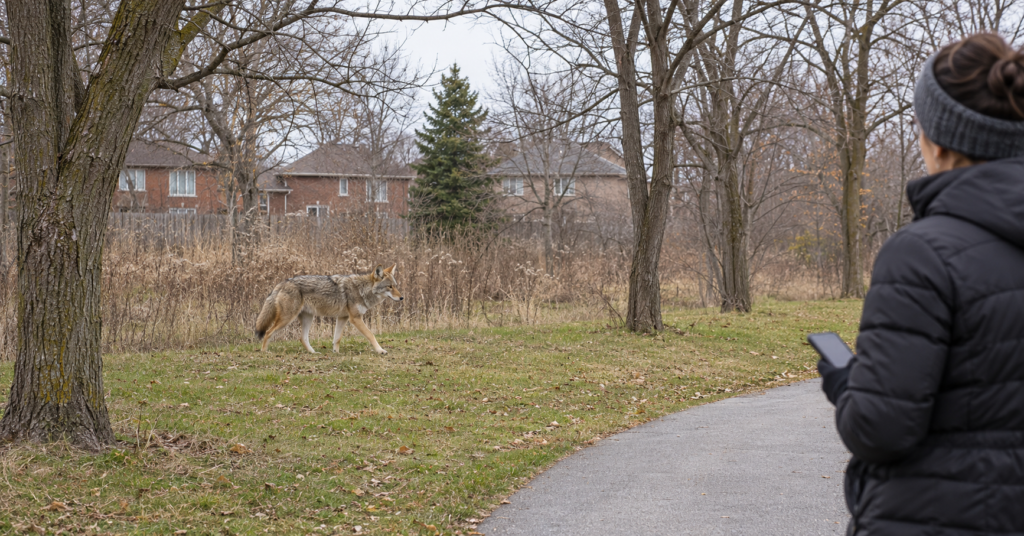
A coyote crosses a neighbourhood path and disappears behind a fence. Later, someone posts that an aggressive animal is roaming the area. Before sharing that description or filing a report, separate what you observed from what you heard.
Mississauga coyote sightings can involve very different situations: an animal moving through an empty yard, one approaching a person or an injured animal beside a road. The reporting route should match what is happening now. Clear details help Animal Services assess the concern without relying on an alarming label.
Deal With Immediate Danger Before Recording Details
Put distance and safety ahead of a photograph. Do not follow a coyote to establish where it went or approach it for a clearer identification.
Mississauga advises people to stay calm and avoid turning their backs or running. If a coyote approaches, the City recommends standing tall, waving your arms and making noise to discourage it. Keep dogs on a short, non-extendable leash rather than allowing them to approach the animal.
For an animal that is visibly sick, injured, in distress or acting aggressively toward people or pets, the City’s animal-emergency instructions direct residents to call 905-896-5858 and choose option 1. The service is available for animal emergencies around the clock.
Call 911 when an attack creates an immediate threat to public safety or someone requires immediate medical attention. Do not wait to complete an online sighting form during an emergency.
Describe Behaviour Instead of Calling Everything Aggressive
Write down the action you saw. “Walked across an unoccupied yard” conveys something different from “followed us along the path and continued approaching after we stopped.”
Mississauga’s incident-classification framework distinguishes ordinary sightings from encounters involving people or pets. It also distinguishes approaching or following from an attack. Those differences inform the City’s response.
Useful observations include whether the coyote:
- Passed through without changing direction toward anyone
- Entered a yard where a pet was present
- Approached or followed a person or animal
- Made physical contact
- Appeared injured or had difficulty moving
Avoid estimating the animal’s intentions. Report the movement, distance and sequence as accurately as you can.
Seeing an animal near homes does not, by itself, establish that it chased someone. Equally, do not omit following behaviour simply because no contact occurred.
Give a Location Someone Else Can Find
Use the nearest street address, intersection, park entrance or identifiable trail junction. “Near the creek” may describe a large area with several access points.
For a trail observation, name the entrance you used and explain approximately how far you had travelled. Mention a bridge, numbered marker or other permanent feature if one was visible.
Record the direction the animal travelled, but distinguish a confirmed location from a guess. For example:
“Seen beside the east entrance at approximately 7:20 a.m.; it moved toward the wooded area. I did not see where it went afterward.”
For a private yard, provide the address through the official reporting channel. There is no need to publish a resident’s full address in a neighbourhood group.
Record the Time and Whether the Animal Is Still Present
Include the date and approximate observation time. If you are reporting later, make that clear.
A coyote seen ten minutes ago and one seen yesterday require different location descriptions. Do not describe an animal as currently present unless you can confirm that from a safe position.
If several sightings occurred, list them separately. Two observations in the same area do not establish that the same animal was involved.
When relying on another person’s account, identify it as second-hand information. Encourage the original observer to provide their own report rather than combining several stories into one supposedly confirmed incident.
Use Online Reporting for Suitable Sightings
Mississauga provides an interactive coyote map with a reporting form. Its guidance asks users for details such as the location, date, time and type of observation. The City explicitly says the online system should not be used for immediate reports involving sick or injured coyotes or animals posing a public risk.
Use the City’s current coyote information page to find the appropriate reporting option. If the situation has become urgent, use the animal-emergency contact instead.
For a non-emergency question about which service applies, Mississauga’s 311 service can help. Dial 905-615-4311 from outside the city or if a call near the boundary connects to another municipality.
Save any confirmation or reference number you receive. That makes a later update easier to connect with the original report.
Photograph Only From a Safe Position
A photograph may help describe the animal or location, but it is not worth reducing your distance from wildlife.
If you already have an image, keep the original file and note when and where it was taken. A wide image showing the surroundings can help locate the observation; an enlarged, blurry crop may provide less useful context.
Do not lure an animal with food, surround it with neighbours or let a dog approach to capture its reaction.
Describe visible physical concerns without diagnosing them. “Patchy fur around the hindquarters” is an observation. Declaring that the animal has a particular disease requires an assessment you cannot make from a distant photograph.
Review Food Sources and Pet Routines
A report is also a reason to inspect what may attract wildlife around your property.
Mississauga recommends feeding pets indoors or removing bowls after feeding and cleaning up pet waste. Its coyote guidance also highlights spilled birdseed, which can attract smaller wildlife that coyotes prey on.
Check outdoor areas with other household members so the routine is consistent. Someone may remove a bowl each evening while another person leaves food out during the day.
If a dog walker or pet sitter visits, explain any recent encounter factually and agree on an alternative route if needed. Our guide to creating an emergency contact plan can help organize the people to contact when normal household arrangements change.
Keep Neighbourhood Updates Accurate
A useful community message states the place, time and observed behaviour. It should help others make informed decisions without encouraging a search for the animal.
Avoid reposting an old image as a current sighting. Check dates before forwarding alerts, and correct your message if you learn that the location was wrong.
Do not organize a group to chase, corner or relocate a coyote. Follow Animal Services’ instructions and leave any investigation or response to the appropriate personnel.
If something materially changes after your report—such as an animal becoming visibly injured or approaching people—make a new contact through the appropriate urgent route rather than assuming staff are monitoring a social-media thread.
Frequently Asked Questions
Is every coyote sighting an emergency?
No. Mississauga distinguishes routine sightings from encounters and attacks. Report the behaviour you observed and use the urgent contact when an animal poses an immediate concern.
Should I use the online map for an injured coyote?
No. The City says its online sighting system is not intended for immediate reports involving sick or injured coyotes. Call Animal Services at 905-896-5858, option 1.
Do I need a photograph before reporting?
Do not delay an urgent call to obtain one. Provide the location, time, behaviour and whether the animal is still present. Only take photographs from a safe position.
Will a report automatically result in removal?
Do not assume that outcome. The City’s response framework varies according to the circumstances and reported behaviour; a routine sighting is treated differently from an attack.
Note: Contact instructions and reporting tools can change. Consult the City of Mississauga’s official coyote guidance for current safety advice and reporting resources.