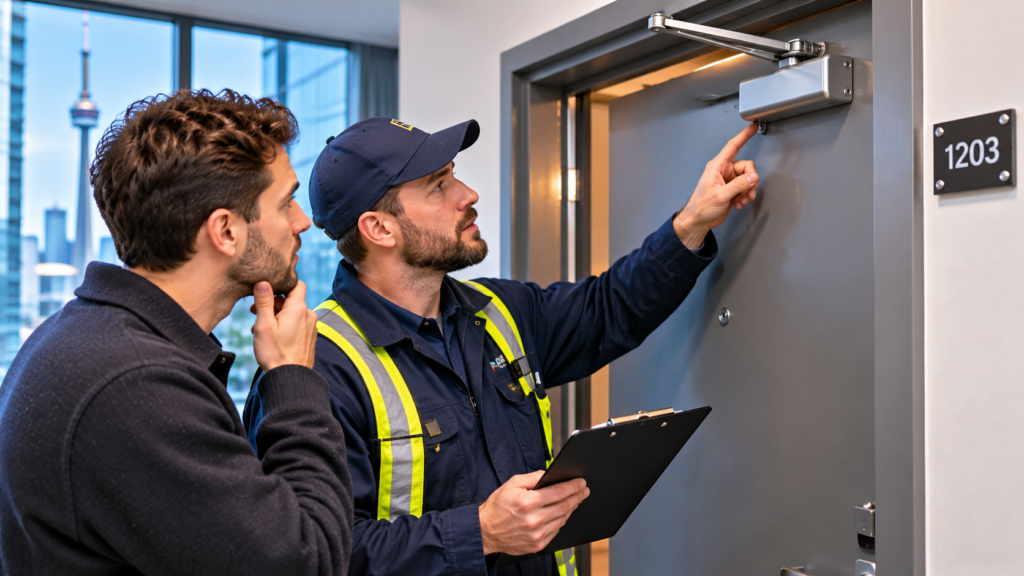
An apartment entrance door that stops short of its frame can look like a minor inconvenience. You might give it an extra push each time you leave and assume the problem can wait. However, a door that no longer closes properly deserves prompt attention.
Toronto apartment door closers help doors return toward the closed position. The closer, hinges, frame and latch must work together; a problem with any part can affect the result.
Before reporting a fault, make a few safe observations during normal use. You do not need to diagnose the mechanism, adjust its settings or prove that a regulation has been breached. A clear description helps management understand what needs inspection.
Understand Why Closing Matters
Toronto’s high-rise fire-safety guidance explains that suite doors must close automatically to protect openings in the building’s fire compartments. A door’s closing function therefore serves a purpose beyond convenience or noise control.
This article focuses on recognizing and reporting problems with apartment entrance doors. It does not establish the requirements for every door in every building.
If you are unsure how your door is intended to operate, ask management to explain its normal function. Avoid assuming that an interior bedroom door and a suite entrance should behave identically.
Identify the Exact Problem
Watch what happens when you use the door normally, keeping hands, feet, children and pets clear of its path.
Several different observations can be useful:
- The door begins closing but stops before reaching the frame.
- It reaches the frame but does not latch.
- It closes much faster than it previously did.
- It scrapes, catches or requires unusual effort.
- A closer arm or mounting point appears loose.
- Fluid appears beneath or around the closer.
- The behaviour changed after recent work.
Describe the result rather than naming a replacement part. “The door stops several centimetres short” is more useful than “the hydraulic unit needs replacing” when nobody has assessed the cause.
Distinguish Closing From Latching
A door can appear closed without its latch engaging. Conversely, a latch may work when you pull the door shut even though the closer does not bring it there independently.
Report those observations separately. Do not rely on the sound of a slam as proof that the door is secure.
Keep your key available when observing the door during ordinary entry or exit so you do not accidentally lock yourself out.
Look for Obstructions Without Altering Hardware
Check whether belongings under your control interfere with the door’s movement.
A loose mat, shoe or bag near the doorway may be visibly in its path. Move your belongings clear where safe, then tell management if the problem remains.
Leave attached components alone. Do not remove seals, trim the door, loosen screws or alter the threshold to make it close.
If a new mat or other recent change coincided with the problem, include that information in your report. It may help maintenance staff narrow down the inspection without repeated visits.
Record When the Fault Occurs
An intermittent problem can be difficult to explain if you describe only the most recent incident.
Note when you first noticed it and whether it happens every time. Record relevant circumstances you have already observed, such as the door behaving differently after a corridor window opens or following work on the frame.
Do not deliberately change ventilation, obstruct another door or recreate unsafe conditions to test a theory.
A short video may help demonstrate the fault if you can record it safely during normal use. Avoid capturing neighbours, visitors or the inside of another unit.
Leave Adjustments to Maintenance Staff
A closer that slams can be frustrating, particularly late at night. A heavy door can also make everyday access difficult.
Neither problem should be addressed by disconnecting the arm or experimenting with adjustment screws. Changes to closing behaviour need assessment in the context of the complete door assembly.
Ask management to arrange appropriate inspection and adjustment. If the problem affects your ability to enter or leave, explain that practical difficulty clearly.
Raise Accessibility Needs Directly
Describe what you experience rather than requesting a specific mechanical setting.
For example, explain that you cannot comfortably hold the door while using a mobility aid or that its movement makes passing through difficult. Ask management to assess an appropriate arrangement that preserves the door’s required functions.
A door should not have to be wedged open as an everyday workaround.
Submit a Written Request With Useful Details
Report a closing or latching fault promptly through the building’s established maintenance channel. If it presents an immediate access or security concern, contact the superintendent or designated urgent-maintenance contact as well.
Include:
- Your building address and unit number.
- Which door is affected.
- What happens during normal use.
- When the problem started.
- Whether the door currently closes and latches.
- Any relevant photographs or previous request number.
Toronto’s RentSafeTO guidance advises tenants to submit service requests in writing and keep copies. It also recommends contacting the landlord or property owner first about apartment maintenance issues.
For broader move-in checks, our guide to inspecting an older Toronto rental can help you organize other concerns separately.
Ask About the Response and Interim Arrangements
Request confirmation that management received the report and ask when someone will inspect the door.
If it cannot latch, makes access difficult or appears unstable, explain that explicitly. Do not describe every problem simply as “a noisy door,” because that can obscure the actual concern.
For buildings covered by RentSafeTO, the City publishes response requirements of 24 hours for urgent requests and seven days for non-urgent requests. Its examples include broken locks as urgent security matters. These are response requirements, not a universal promise that every repair will be completed within that period.
Ask management what to do until inspection. Avoid accepting an improvised arrangement that leaves a required closing mechanism disabled.
Follow Up if the Fault Remains
If the issue is unresolved, send a follow-up referencing the original request. State whether the condition has changed and whether anyone has attended.
Toronto advises tenants with persistent, unresolved maintenance complaints to contact 311. Explain both the closing fault and any related security or fire-safety concern so the City can direct the inquiry appropriately.
Keep any City reference number and respond to requests for information.
An active fire, smoke emergency or immediate threat requires emergency assistance, not a routine maintenance complaint. Follow your building’s fire-safety plan and emergency-service instructions.
Check the Outcome After Repair
Ask the person completing the work to demonstrate normal operation.
Observe whether the reported sticking, closing or latching problem remains. You do not need to force the door, repeatedly slam it or conduct your own compliance test.
If the repair works initially but the fault returns, record when it recurred and notify management. Referencing the earlier work helps distinguish a repeat problem from a new request.
Keep the completion message with your original report so the maintenance history remains easy to follow.
Frequently Asked Questions
Is a door closed properly if it touches the frame?
Not necessarily. Describe whether the latch engages as well as whether the door reaches the frame. Ask maintenance staff to assess uncertain operation.
Can I adjust a slamming door closer myself?
Leave adjustment to the responsible maintenance personnel. Report the speed, noise and any difficulty passing through the doorway.
Should I wait until I know which part is broken?
No. Report the observable problem promptly. Identifying the technical cause is part of the inspection.
Can I disconnect the closer while waiting for repair?
Do not disable it. Ask management for appropriate interim instructions, particularly if closing or access is affected.
What if management says the repair is finished but the fault continues?
Reply with a specific description of the remaining problem and reference the original request. Keep records of the follow-up.
Note: This article provides general observation and reporting guidance, not a technical inspection. Requirements depend on the door and building. Review Toronto’s high-rise fire-safety guidance and learn the approved fire-safety plan for your property.