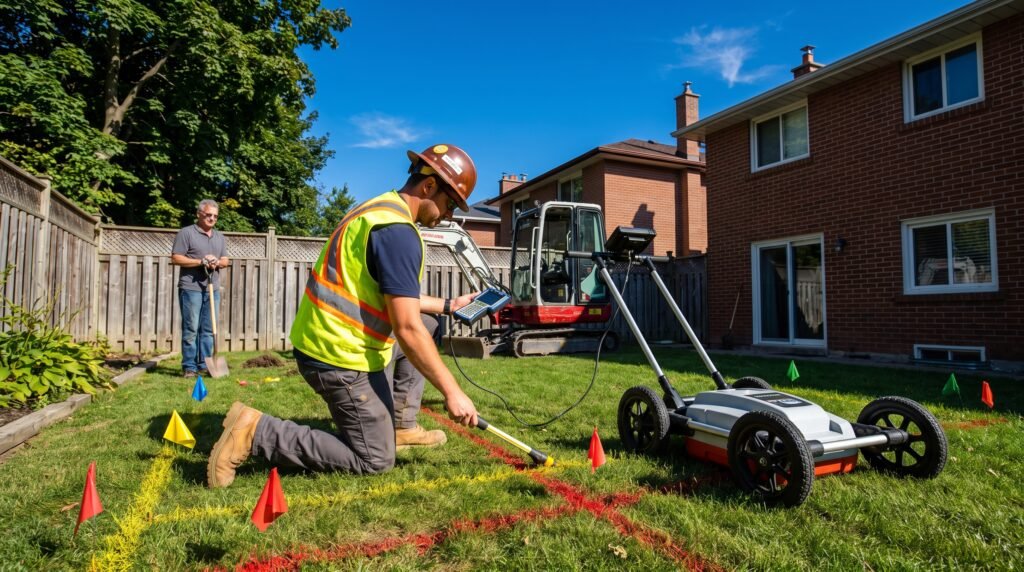
Replacing a fence post or expanding a garden bed can feel like ordinary weekend maintenance. However, the ground beneath a Toronto backyard may contain infrastructure that is not visible from the surface. A clear lawn does not establish where buried cables or pipes run.
Preparing for Toronto backyard digging involves more than submitting a request and waiting for paint marks. You need to confirm what area the request covers, whether every required response has arrived and whether privately owned lines need separate attention.
These checks help you plan the work without treating a small project as automatically low risk.
Start With an Accurate Description of the Work
Before requesting locates, decide where you intend to disturb the ground. Describe the actual project rather than using a broad label such as “backyard improvements.”
For a fence replacement, identify the proposed post locations and any other excavation involved. For a landscaping project, include the areas where soil will be removed, rather than only the final position of a garden feature.
Prepare the information requested by the locate system, including the address, work area, excavation details and planned start date. If you are unsure how to identify the location accurately, use the authority’s instructions or ask for help.
A useful planning question is: could someone unfamiliar with your yard understand exactly where the work will happen from the information you provide?
Request Public Locates Before Scheduling Excavation
Ontario Dig Authority, formerly Ontario One Call, coordinates public utility locate requests. Its published guidance covers projects such as planting trees, building fences and landscaping, as well as larger excavation work.
For a single-address project, it instructs people to contact the authority at least five business days before digging. Larger or multi-address projects require more lead time. Public utility locates are free.
Build this step into your schedule before arranging equipment or committing to a contractor’s excavation date.
Avoid treating the requested start date as proof that the site will be ready. The response status and conditions matter when deciding whether work can proceed.
Wait for the Complete Locate Package
One visit from a locator does not necessarily complete the process. Different infrastructure owners respond separately.
Ontario Dig Authority says excavation cannot begin until all responses have been received and marked complete on the Locate Confirmation Sheet. The complete package includes the request confirmation, owner responses, clearance documentation, marking information and applicable safety instructions.
Keep these documents together. Check the listed owners against the responses received rather than relying on the number of flags in the yard.
A response may provide clearance instead of field markings. Read what that clearance covers; an absence of paint alone does not explain the status.
If a response is missing, contact the relevant infrastructure owner or locate provider using the information associated with your request. Do not replace an outstanding response with your own assumption about where a line probably runs.
Identify Privately Owned Underground Lines
Public locates do not necessarily identify everything buried on your property.
Ontario Dig Authority explains that privately owned infrastructure can require a separate private locate. Examples include gas lines serving a barbecue or pool heater, electrical lines to a shed or detached garage, and lines supplying certain lights or security cameras.
Walk through the property and note features that may have underground connections. Look beyond the main house: a powered outbuilding or outdoor installation can raise a separate question.
Gather installation records if you have them, but use those records to explain what may exist rather than assuming they establish its current position.
Ask what infrastructure remains outside the public locate process and what assessment is needed before digging. This is especially useful when previous owners installed backyard equipment.
Clarify Responsibilities With Your Contractor
Hiring someone to perform the work should come with a clear discussion about locates.
Ontario Dig Authority’s guidance says the person performing the excavation should submit the request.
Before work starts, ask the contractor to confirm the request number, the area covered and whether the complete package is available. Discuss how possible private lines will be addressed.
Put these arrangements in writing alongside the project scope. A brief email can record who is handling each step and what remains outstanding.
If you have already obtained documents yourself, ask whether they are suitable for the contractor’s proposed work. Do not assume that paperwork for an earlier project automatically covers a new excavator, location or method.
Read the Instructions, Not Just the Colours
Flags and paint help communicate where infrastructure has been located, but they do not provide the entire set of excavation instructions.
Review the accompanying documents for restrictions, special requirements and directions applicable to the work. Make sure the person operating tools or equipment has access to them.
If the markings and paperwork appear inconsistent, stop planning around the disputed area and request clarification. The same applies when a marked route conflicts with the proposed position of a post or trench.
Do not interpret the marks as permission to use any digging method immediately beside a line. Follow the infrastructure owner’s instructions and obtain appropriate guidance where the work requires expertise beyond your experience.
Check Validity When the Project Is Delayed
Weather, contractor availability or a change in plans can push backyard work beyond its original date.
Check the validity period and conditions stated in each locate document. Ontario Dig Authority advises that validity is determined by the infrastructure owner, so the applicable paperwork is the place to confirm it.
Save the documents somewhere accessible and add a reminder to review them before the rescheduled start.
Also inspect whether markings remain visible. Ask for guidance if they have faded, been disturbed or become difficult to interpret. A photograph can help document what was present, but it should not be treated as a replacement for the required field information.
Revisit Locates When the Digging Area Changes
A project can change after an initial assessment. You might move a fence line, add another post or extend a trench to reach a different location.
Ontario Dig Authority states that changed projects require a new locate request.
Compare the revised plan with the area originally submitted before any additional excavation occurs.
For example, moving a proposed feature to another side of the yard may introduce infrastructure that was irrelevant to the first request. Update the plan while the change is still on paper.
Ask the contractor to flag proposed changes before acting on them. This gives you an opportunity to resolve locate coverage and other requirements without an open excavation waiting for answers.
Keep Permits, Boundaries and Tree Protection Separate
Utility locates address buried infrastructure. They do not establish your property boundary or settle whether a fence, deck or other project needs municipal approval.
Check those questions separately before construction. Toronto’s construction guidance also calls for protecting neighbouring property, trees and plants during work.
Where digging may affect a tree near the street, our guide to Toronto street trees explains why ownership and authorization need attention.
A useful project folder can hold the survey or boundary information, applicable approvals, locate package and written contractor scope. Keeping them together makes it easier to see which question each document answers.
Report Damage Even When It Looks Minor
If underground infrastructure is damaged, stop work immediately.
Ontario Dig Authority advises calling 911 when there is immediate danger to people or property, then notifying the affected infrastructure owner as soon as possible. Its guidance includes reporting minor damage, such as a nick to protective coating, and leaving the excavation exposed until inspection.
Do not attempt an improvised repair or bury the affected area to finish the project. Follow emergency instructions and keep others away from any hazard.
Helpful Public Resources
- Ontario Dig Authority: Locate Overview: Public and private locate responsibilities.
- Ontario Dig Authority: Complete Locate Package: Documents and responses needed before excavation.
- City of Toronto Construction Requirements: Municipal construction guidance.
Note: This article provides general planning information, not site-specific excavation instructions. Confirm current requirements, complete responses and private infrastructure arrangements before digging. Follow the conditions in your locate documents and check municipal approvals separately.